The goldcrest and firecrest are two of the smallest British birds and to the untrained eye can look almost the same.
You’re more likely to spot the more numerous goldcrest and it regularly turns up in gardens and parks. Firecrests are much rarer birds with just 500 breeding territories.
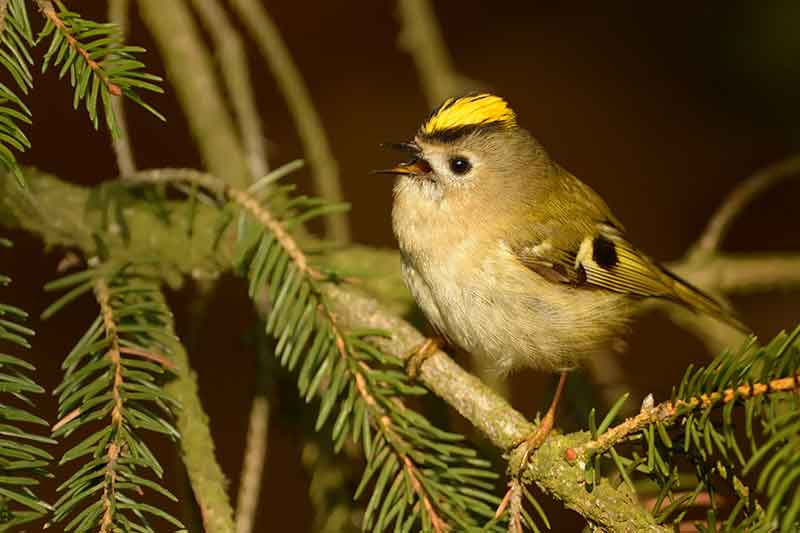
Goldcrest

Yellow patch on the crown
1 of 4Pale eye-ring
2 of 4Dull olive-green plumage
3 of 4White marks on the tertial feathers
4 of 4The goldcrest is the slightly smaller of the two at just 9 cm in length. It has a tubby, round appearance with dull olive-green plumage and white spots on the tertial feathers.
It has plain head markings with a yellow patch on the top of its crown bordered with black, and a pale eye-ring which gives it a cute, very appealing expression.
Its contact call is high pitched in phrases of two to four calls in an uneven rhythm, while its song is an undulating series of notes that finish with a final flourish.
Goldcrests are found across the UK in any areas with coniferous trees. In autumn and winter they will form flocks with other small birds such as tits and can be found in trees hunting for insects and spiders.
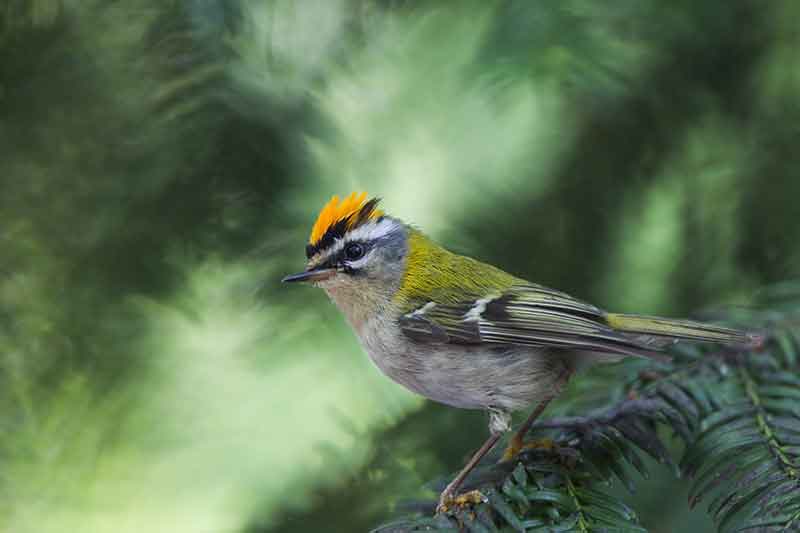
Firecrest

Orange patch on the crown
1 of 4Black and white eye stripes
2 of 4Brighter plumage
3 of 4Bronze shoulder patch
4 of 4The firecrest is larger at about 10 cm in length but weighs the same so is less dumpy. It has much brighter and cleaner plumage with a green back and white belly, and a chestnut patch on the shoulder.
On the head, the crown is a more brilliant orange, particularly in males, and it has a black stripe through the eye and a white stripe, or supercilium, above the eye, which gives it a rather grumpy look.
Its contact calls are at a lower pitch and have a softer tone, and its song is less jaunty with the single repetition of a single note and few flourishes.
They are more likely to be spotted foraging low near the ground and are found mainly in the south-east of England and southern Wales.