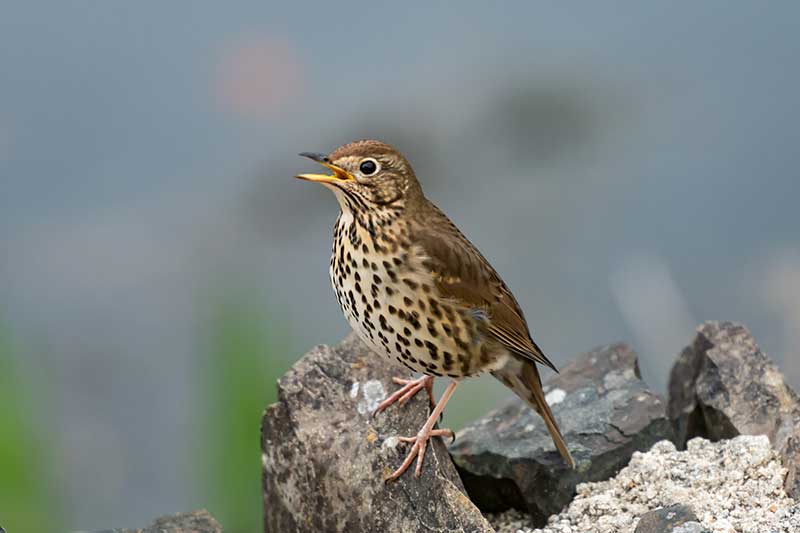
The UK is home to six species of thrush but the two that look the most similar and can cause confusion are the song thrush and mistle thrush.
Song thrush

Spots shaped like upside-down hearts
1 of 3Appears warmer brown overall
2 of 3More compact and evenly proportioned
3 of 3The song thrush is the more familiar thrush, that often visits gardens. It is has a compact, rounded body with fewer spots on the belly and flanks, and is a warm brown colour overall. On the head the cheeks are dark and the bill has yellow on its lower mandible.
The song thrush has a loud, clear song with repeated phrases. They will often start singing as soon as dawn breaks and get going again at dusk.
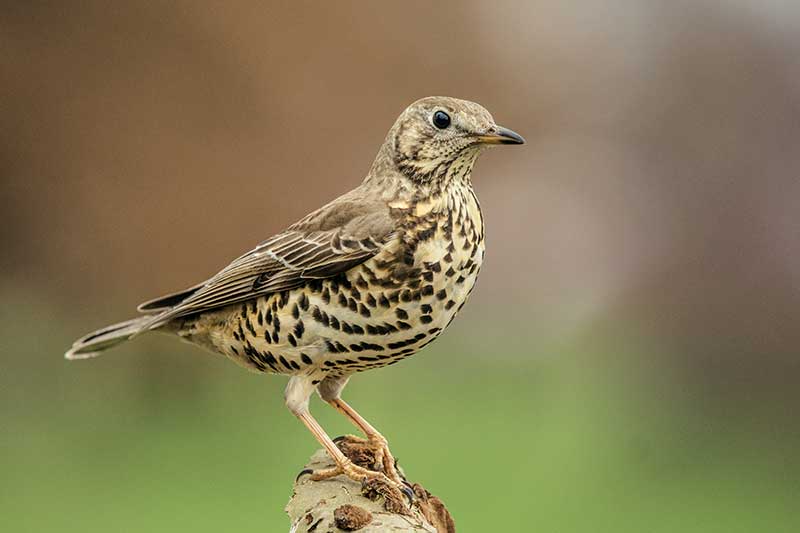
Mistle thrush

Spots are more rounded
1 of 3Spots converge at the sides of the breast
2 of 3Pale outer tail feathers
3 of 3The mistle thrush, which is the largest of the UK thrushes is a less common bird. It is greyer with an elongated body and neck, and a fatter belly. It has white edges on the wings and tail. The spots are less well defined and has more spots on the belly and flanks. On the head the cheeks are pale and the bill is black.
The mistle thrush has a more melancholy song but has a habit of singing in all weathers. Its distinctive call is similar to a football rattle.
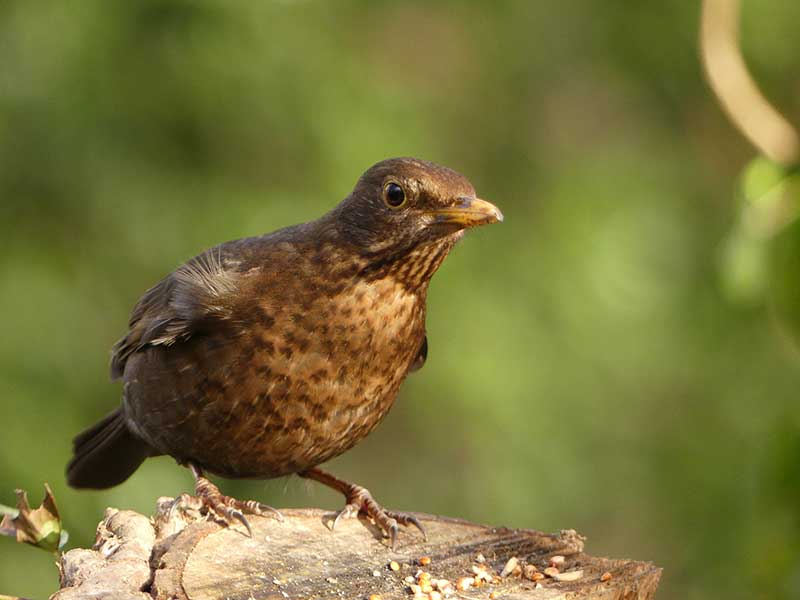
Female blackbird

Another bird that can sometimes cause confusion is the female blackbird. Male blackbirds are dark overall but female blackbirds are lighter and have spots on their breasts. But even the palest female blackbird is not as pale as the song or mistle thrush, and she has a fully yellow beak.