|
|
UK Set To Welcome An Irruption Of Waxwings This Winter

UK Set To Welcome An Irruption Of Waxwings This Winter

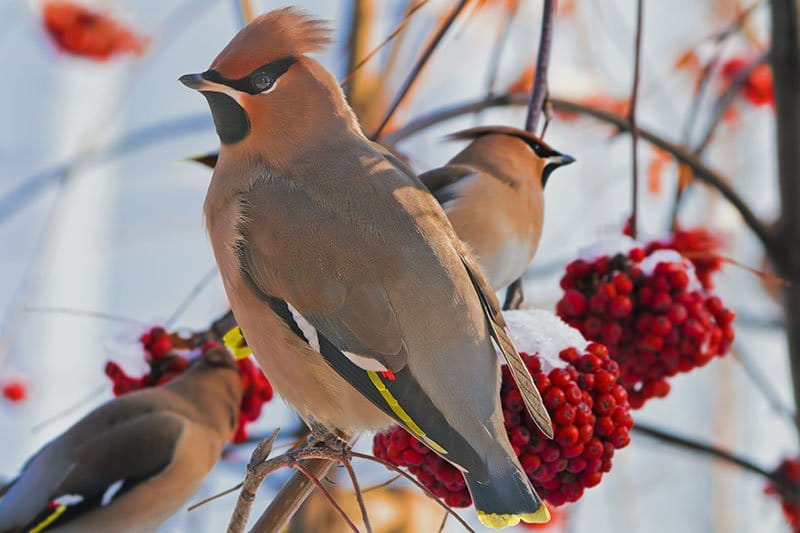
Bohemian Waxwings

It’s been predicted that this winter could see large numbers of waxwings visit the UK, in a phenomenon that occurs only once every few years.

The Bohemian waxwing is a stocky bird with short legs, a head crest, and distinctive patterns on its wings and tail. Overall, the male has soft, pinkish-grey plumage with a paler rump and underparts, and a rufous patch under its tail. The black wings have yellow and white stripes, and long, bright red tips that look a little like sealing wax and which give the bird its name. The head is reddish-brown with a black face mask, and it has a short, pink upright crest.

The female is very similar to the male but has less distinct markings, while juveniles are duller with a much shorter crest and a smaller face mask.

The genus name comes from the Greek ‘bombux’ for silk and the Latin ‘cilla’ for tail, and refers to the silky-soft plumage of the bird. The species name is the Latin for ‘talkative’ and is a reference to the supposed visual likeness of waxwings to jays, rather than its vocalisations which are far-carrying trills, ands sound just like the calls of the blue tit and greenfinch in spring.

Your next read

Bird Spotter Sheets For Kids
10 Record Breaking Birds
Shop Squirrel Proof Feeders And Baffles
Rufous-Tailed Scrub Robin ID Guide

Waxwings keep their soft feathers in good condition by preening, and the preening oil of Bohemian waxwings has been shown to increase the UV reflectance of their red and yellow feathers keeping them looking extra bright.

The red waxy tips are the extended and flattened ends of feather shafts enclosed in a transparent coating. The colour comes from carotenoid pigments found in the fruit and berries the waxwings eat, and as the birds get older, the waxy tips get bigger.

Unlike may songbirds, waxwings don’t hold breeding territories, and although they normally breed in solitary pairs, they will sometimes form small groups that nest close together if an area has a number of particularly good nest sites.

They have a wide range, and during breeding season are found in the north of Europe, Asia, and North America in mixed coniferous woodlands, as well as open areas with water, such as lakes, ponds, and streams, where they feed on insects.

In winter, they move south in search of fruit and berries. They have an amazing ability to find fruit nearly anywhere sometimes turning up in scrubby areas in huge flocks to find an isolated shrub which they strip bare in minutes, before taking off again.

Rowan is a particular favourite, but they also eat juniper, cotoneaster, hawthorn, rose hips, cranberries, mulberries, bilberries, and brambles. Because fruit is high in sugar, but low in other nutrients, waxwings need to eat vast quantities of it and have evolved an extra large liver to help convert the sugar into energy.

Bohemian Waxwings

Although they can metabolise the ethanol produced from the fermentation of fruit better than humans, they can still get drunk, sometimes with fatal results. To help prevent dehydration caused by their sugary diet they can often be seen eating snow in winter.

If it has been a poor year for a berry crop in their usual wintering grounds due to the natural fruiting cycle or adverse weather, then they may move south further than their range in what is known as an irruption. This year a poor crop of rowan berries in Finland and Sweden has prompted waxwings to do just that and so it was that a lone bird turned up in Unst Shetland last week.

Since then, more have been spotted in Scotland as well as Cumbria and Norfolk, and thousands more are expected to arrive over the coming weeks.

The UK last experienced an influx of waxwings in the winter of 2016/17 but the last proper “waxwing winter” as they are known in birding circles occurred in 2012/13. Thousands of the birds were spotted in supermarket car parks, housing developments, industrial estates, gardens, and other urban areas planted with rowan and hawthorn.

It’s thought that the largest ever waxwing irruption occurred in Europe in the winter of 2004/5 when over half a million waxwings arrived in Germany alone. This followed an unusually warm and dry breeding season which would have increased reproductive success and put even more pressure on the food supplies on the waxwing’s usual wintering grounds.

It’s still early days, but with significant numbers having already moved to the south of Sweden it’s more than likely they will continue to move west and arrive in the UK in the next fortnight.

Have you spotted a flock of waxwings this year? Let us know in the comments below..

You can also track sightings of waxwings by following on @WaxwingsUK on Twitter.
Share your thoughts

4 Responses

Leave a Reply

Your email address will not be published. Required fields are marked *

More notes and news

All That Breathes
All That Breathes – Two Brothers On A Mission To Save The Black Kite
October 20, 2022
Snowdon Aviary
Defying Gravity – The Snowdon Aviary
July 11, 2020
Siskins
Chinese Startup Unveils AI That Translates Birdsong
April 1, 2025
Blue-Grey Tanager
We Went All The Way To Costa Rica …
February 22, 2020
Long-Tailed Tit
Long-Tailed Tits Fly Into 2020 Top Ten
April 2, 2020
Bird Photographer Of The Year 2020 Winners Announced
August 15, 2020

Secure your bird watchig break for just £10

Secure your bird watchig break for just £10

Secure your bird watching break for just £10