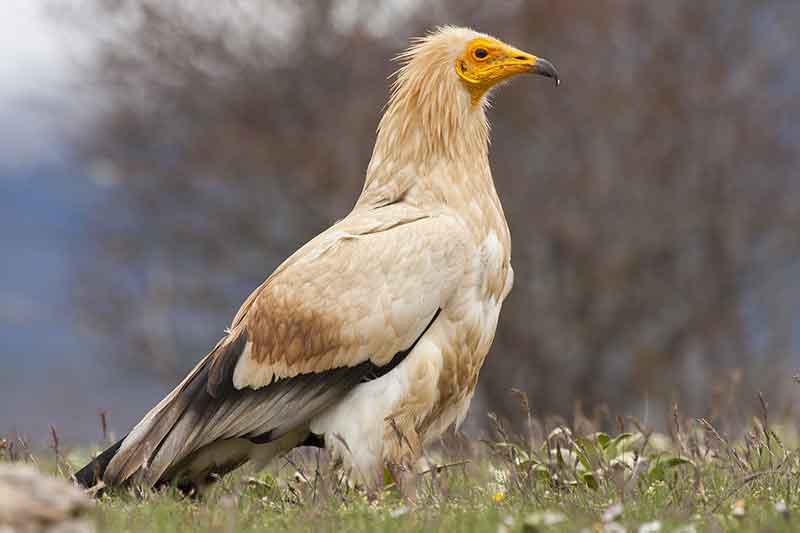
An Egyptian vulture has been spotted in the UK for the first time in over 150 years.
The bird arrived on the Isles of Scilly yesterday and is thought to have come from Northern France. If it is a wild bird, then it would be the first official recording since 1868 when an immature bird turned up in Peldon in Essex. A local farm labourer shot that bird after he’s caught it feeding on a pile of geese, recently slaughtered for Michaelmas.
The vulture was sent to a taxidermist in Colchester where Dr Bree, a senior physician at Essex and Colchester hospital, was able to examine it. After studying it, he lent it to John Gould who commissioned Joseph Wolf to make a drawing and included it in The Birds Of Great Britain with a picture of the pyramids behind it.
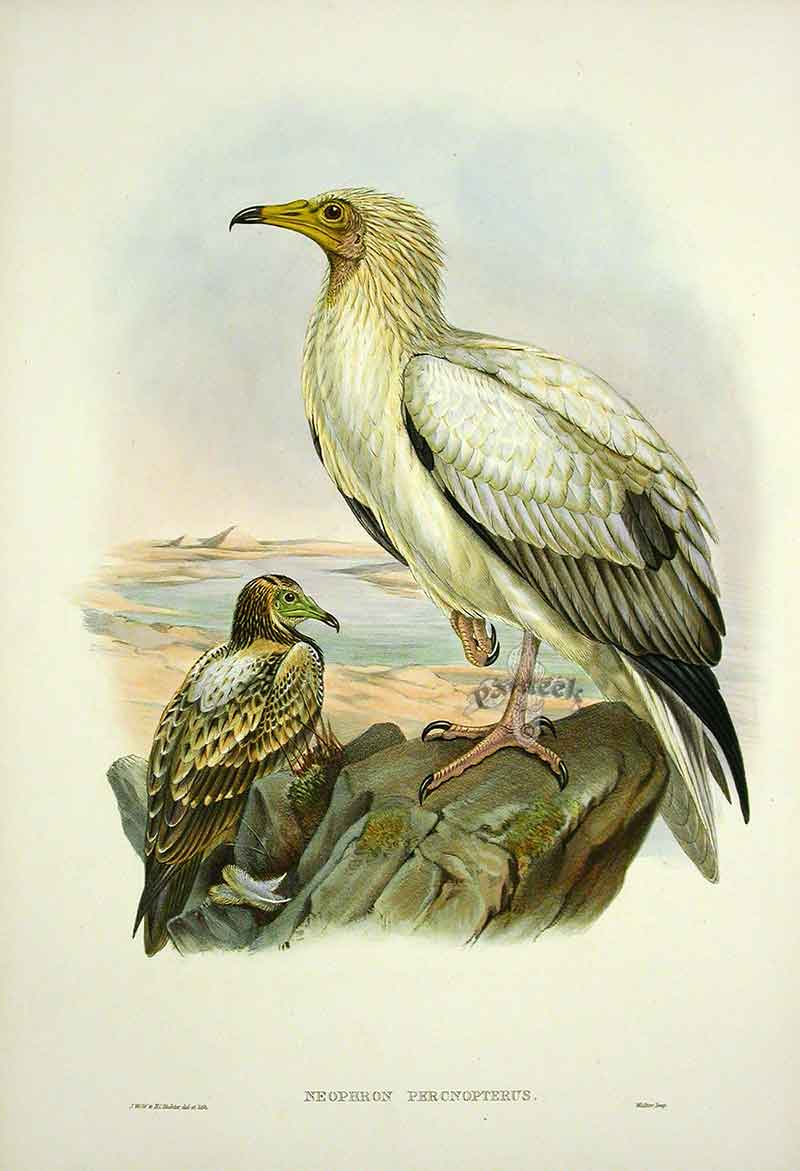
Prior to that, in 1825 another immature bird was spotted in Bridgwater Bay in Somerset and Bristol, but regrettably this bird too was shot.
More recently two Egyptian vultures were seen in Norfolk in 2007 and 2012. However, these birds were more than likely escapees from captivity and so were rejected by the British Ornithologists’ Union.
The Egyptian vulture, also known as the white scavenger vulture, or Pharoah’s chicken, is an Old World vulture. It weighs just 2 kg and has a wingspan of about 150 cm, making it one of the smallest vultures in the world. It has white plumage and a distinctive yellow face, with a long, slender, hooked bill and an elongated, horizontal nostril. It sometimes has a rusty wash to its plumage derived from rubbing itself with iron-rich soil.
Like many vultures, its talons are relatively weak and are adapted for flying rather than holding onto prey. It is an opportunistic feeder, eating mainly carrion, but it will also take small reptiles and mammals, eggs, and fruit, as well as faeces.
Fredrik Hasselqvist, the Swedish naturalist, who studied under Carl Linnaeus, but was disappointed about the lack of information about the natural history of the Levant, so made his own journey there, described the Egyptian vulture thus:
“The appearance of the bird is as horrid as can well be imagined. The face is naked and wrinkled, the eyes are large and black, the beak black and crooked, the talons large, and extended ready for prey, and the whole body polluted with filth. These are qualities enough to make the beholder shudder with horror. Notwithstanding this, the inhabitants of Egypt cannot be enough thankful to Providence for this bird. All the places round Cairo are filled with the dead bodies of asses and camels; and thousands of these birds fly about and devour the carcasses, before they putrify and fill the air with noxious exhalations.”
During breeding season, the Egyptian vulture can be found across southern Europe, northern Africa, and eastern and southern Asia on dry plains and deserts. It is a migratory bird, and the only European vulture to migrate to Africa for the winter, which means it breeds later in the year than other vultures, laying on average two eggs in April and May.
In the last few decades, its numbers have declined dramatically in Europe. Although it has few natural predators, human activities pose many threats. Hunting, accidental and deliberate poisoning, accumulation of lead from the ingestion of shot from carcasses, pesticides, deforestation, and collisions with power lines, have all contributed to the decline in its population.
The Egyptian vulture is one of the few species of animals known to use tools. In areas of Africa, where ostrich eggs form part of its diet, it uses a pebble held in its beak to hammer and crack open the egg. Studies on wild and hand-reared birds suggest that this behaviour is innate, and it does not learn by copying other birds, but develops the ability once it has associated eggs with food and has access to pebbles.
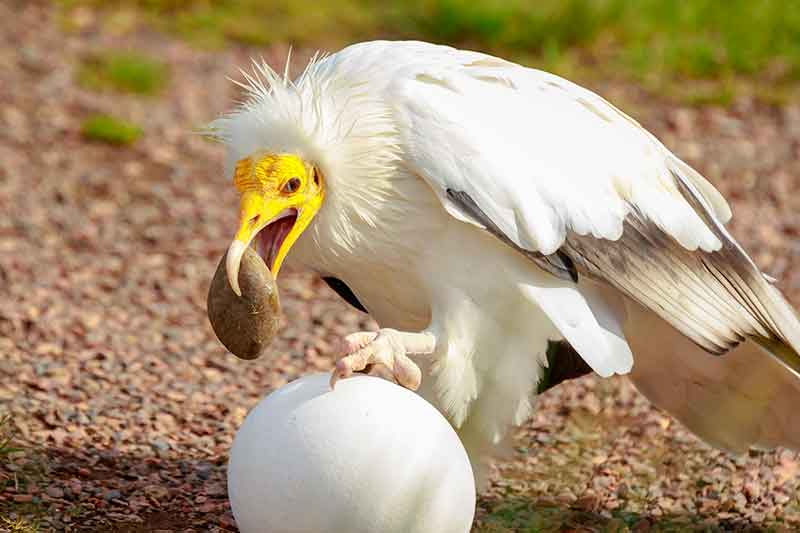
This behaviour was known to Africans and recorded by Victorian naturalists who wrote:
“Two articles of diet which certainly do not seem to fall within the ordinary range of vulture’s food are said to be consumed by this bird. The first is the egg of the ostrich, the shell of which is too hard to be broken by the feeble beak of the Egyptian Vulture. The bird cannot, like the lammergeier, carry the egg into the air and drop it on the ground, because its feet are not large enough to grasp it, and only slip off its round and polished surface. Therefore, instead of raising the egg into the air and dropping it upon a stone, it carries a stone into the air and drops it upon the egg. So at least say the natives of the country which it inhabits, and there is no reason why we should doubt the truth of the statement.”
Interestingly, the author appears to have got confused with the behaviour of the Lammergeier and assumes that the Egyptian vulture is using its talons rather than its beak to open the egg.
In the Bulgarian population, Egyptian vultures have also been observed using twigs to roll up small pieces of wool to use for lining its nest.
The Egyptian vulture has long played an important part in human culture. It is mentioned in the Old Testament in Deuteronomy 14:17 as one of the birds which Jews are forbidden to eat.
“But these are they of which ye shall not eat: … And the pelican, and the gier eagle, and the cormorant.”
The original Hebrew word was rãhãm or rãhãmah which was translated into English by the committee of scholars and clergymen appointed by King James I in 1604 as ‘gier eagle’, an old name for the Egyptian vulture, as it is almost identical to the Arabic name for the bird.