

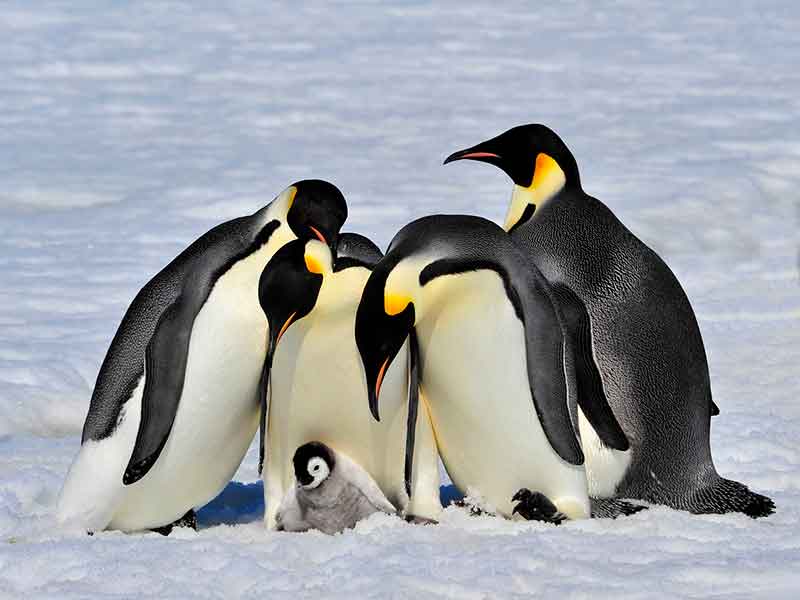
Compared to other penguin colonies, emperor penguin colonies are generally peaceful. Most of the time, the birds quietly huddle together in groups, wander around, or sleep, with only occasional displays. This contrasts sharply with other penguin species, which are highly territorial and often aggressive, using a range of vocal and visual displays to defend and maintain their nesting sites.
Courtship begins with the male lowering his head to his chest and letting out a call for a couple of seconds. He may also turn his head slightly, exposing his vivid ear patches. He moves through the colony, repeating this call until he attracts a willing female. Once paired, the two stand face to face, stretching their heads and necks upward in perfect synchrony.
They then waddle through the colony together, with the female typically following the male. Before mating, they perform a deep bow to one another, sealing their bond.
In May or June, emperor penguins lay a single egg, the only penguin to do so, although in many other species, only one chick survives.
Pale green in colour, the egg measures about 12 cm in length and weighs approximately 460 g, around eight times the weight of a chicken egg. However, it is remarkably small relative to the mother’s size, making up just over 2% of her body weight, one of the smallest egg-to-body ratios of any bird species. Around 15% of the egg’s weight comes from its thick shell, which helps protect it from breakage. For further protection, it is shaped like an avocado, which makes it roll in a circle rather than in a straight line, reducing the risk of it being blown away by strong winds.
With no vegetation or suitable ground for nesting, and the female having exhausted her energy and fat reserves producing the egg, emperor penguins rely on a remarkable strategy to keep their egg safe and warm during incubation.
After laying, the mother carefully transfers the egg to the father, a delicate and often awkward process. Many first-time parents, and even some experienced ones, drop or crack the egg. If this happens, the chick is lost instantly, as it cannot survive even a few minutes on the freezing ice. When a pair loses their egg, they abandon the breeding attempt and return to the sea, only to try again the following year.
If the transfer is successful, the female departs for the ocean to feed, leaving the male to take over incubation. He cradles the egg on the tops of his feet, pressing it against his brood patch, a bare, highly vascularised patch of skin on his belly that transfers body heat to the egg. He then covers it with a loose flap of skin and feathers, keeping it warm at about 38 °C while it incubates for around 70 days.
Male emperor penguins demonstrate remarkable dexterity in keeping their eggs safe. They have been observed scratching the back of their heads with the claws of one foot while balancing and holding the egg securely on the other foot. They can also cross cracks in the ice by dragging themselves across with their beak and flippers, all while keeping the egg safe. Even when they trip over rocks, roll down snowy slopes, or tumble on slippery ice, they rarely release the egg.
One of the biggest risks to the egg occurs when they walk through soft snow, which forces them to lengthen their steps and spread the cradle formed by their metatarsal bones. To minimise these risks, emperor penguins move as little as possible and, after heavy snowfall, wait for birds without eggs to create a path through the snow. Except in the very early stages of incubation, if the egg is accidentally dropped, it is picked up and replaced almost immediately.
During this incubation period, the male does not eat and must endure the brutal Antarctic winter. To survive the bitter cold, biting winds, blizzards, and snowstorms, he huddles with other males, taking turns in the centre of the group for warmth. He also turns his back to the wind to conserve body heat and protect the egg. To further preserve energy, emperor penguins sleep as much as possible – often for 20 or more hours a day, and in some cases, up to 24 hours – helping to stretch their fat reserves and maximise their chances, and that of their chick, for survival.
Over the four months of fasting spent on travel, courtship, and incubation, male emperor penguins can lose up to 20 kg, dropping from 38 kg to just 18 kg.
Due to the thickness of the shell, it can take a penguin chick up to three days to chip its way out of the egg. After hatching, the chick is semi-altricial, covered with a thin layer of silvery-grey down and unable to regulate its body temperature. It relies entirely on its parents for both food and warmth. The chick often hatches before its mother returns from the sea, so the father feeds it “crop milk”, a high-protein, cottage cheese-like substance produced in a gland in his oesophagus. This can sustain the chick for up to a week until the mother returns from her fishing trip.

However, between 10% and 20% of females never make it back, falling victim to the harsh weather or predators like leopard seals or orcas, resulting in the chick’s death.
When the female does return, she recognises her mate by his vocal call among the thousands in the colony. The male may be reluctant to part with the chick he has cared for all winter, but eventually, hunger compels him to leave for the sea in search of food.
The mother then takes over the chick’s care, feeding it partially digested krill, silverfish, and squid stored in her stomach, while keeping it warm by balancing it on her feet. After three or four weeks, the father returns, having fed himself, and brings food for both the chick and the mother, who then leaves for the sea. The parents take turns in this way, one brooding, the other foraging at sea, for about 40 to 50 days. If one parent fails to return, the remaining parent will abandon the chick, leaving it to die. This precarious existence means that only around 19% of emperor penguin chicks survive their first year.


