|
|
Am I Allowed To Take Photographs Of Birds’ Nests And Eggs?

Am I Allowed To Take Photographs Of Birds’ Nests And Eggs?

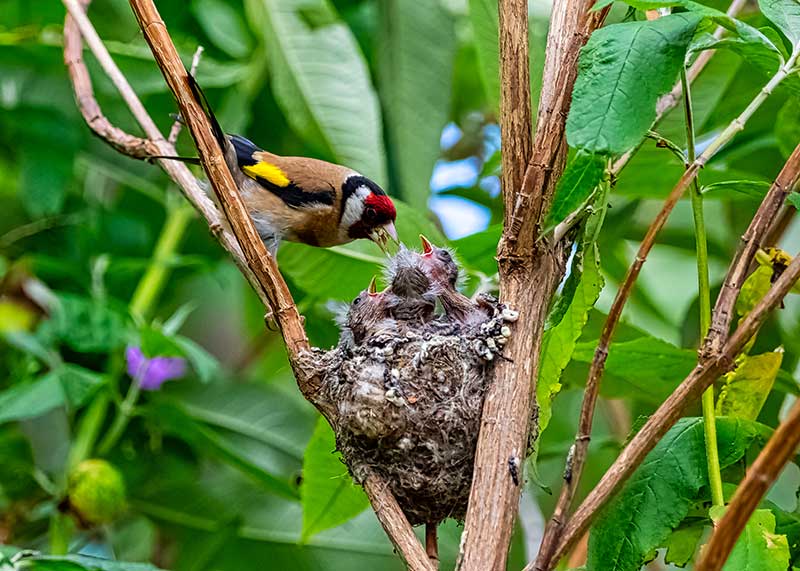
Goldfinch At Its Nest

During spring and early summer, if you’re out and about in the countryside or even in your own back garden, you may come across a bird’s nest. It could be in the early stages or construction, or it may even be housing a bird incubating its eggs or brooding its chicks.

Finding a bird’s nest can be an exciting experience and it may be tempting to try and get a closer look or take a photograph. But you need to be aware that there are laws which protect wild birds and their nests.

Protected by law

In Great Britain, all wild birds are protected under the Wildlife and Countryside Act 1981 including birds that we encounter every day such as pigeons and house sparrows.

For rarer birds, and those vulnerable to persecution or disturbance, schedules attached to the Act give them further protection.

Your next read

10 Record Breaking Birds
Shop Squirrel Proof Feeders And Baffles
A Hisoty Of The Common Crane In Britain
Guide To Smart Bird Feeders
Shop Smart Bird Feeders

You can see the full legislation in the Act about wild birds here but the parts that relate to nests and eggs can be summarised as follows:

For all wild birds it is illegal to intentionally or recklessly:

  • Kill, injure, or take a bird from its natural habitat
  • Take, damage, or destroy the nest of a bird while it is in use or being built
  • Take or destroy birds’ eggs
  • Have an egg in your possession unless you can prove it was collected prior to 1981

For birds listed on Schedule 1 of the Act it is also illegal to disturb:

  • Any bird while it is building its nest
  • Any bird while it is at or near an active nest
  • The dependent young of any bird
  • Any bird while lekking (in Scotland)

This means that it is not an offence to take a photograph of a bird or a bird’s nest even if it is a Schedule 1 bird. If you damage the nest or, in the case of Schedule 1 birds disturb it, or cause a nesting bird to change its behaviour, such as abandoning the nest, while taking a photograph then you would be breaking the law and may be punished with an unlimited fine or a custodial sentence of up to 6 months.

Interpreting by law

The confusion regarding the law comes about because it can be difficult to interpret what is meant by disturbing a bird ‘at or near its nest’. The proximity of ‘near’ is not defined but the legislation was written before the advent of digital cameras and other sophisticated photography equipment which meant that when taking a photo of a birds’ nest,‘near’ would have meant getting very get close.

Bird's Nest

Nowadays, if you take a photograph of a nest from a public footpath using a camera with a long lens, although you technically may be breaking the law, it would be hard for the prosecution to prove that you were near enough to the nest to disturb it.

The other grey area is around the use of hides to observe and photograph Schedule 1 birds and their nests. Again, as long as you can be certain that you are not disturbing the birds as they nest then you are not committing an offence. On the other hand, making noises to attract the attention of birds or leaving the hide to get a closer look would be committing an offence.

If you want to ensure that you are sticking to the letter of the law around photographing Schedule 1 birds, then you need to obtain a licence. Licences are only given out to photographers who satisfy a number of criteria such as those who can demonstrate knowledge of breeding ecology and have the necessary skills to be able to work in the field without unduly disturbing the birds.

Follow the guidelines

Whatever the law says, people also have a moral duty not to put any nesting bird or its eggs or chicks at risk and therefore we recommend that if you wish to take a photo of a nest then you follow some strict guidelines:

  • Keep as far away from the nest as possible. If you need to handle the nest or move vegetation or anything else covering it to get a photo, then you should leave it alone and take just the memory home with you.
  • Stay silent when you are in the vicinity of the nest and do not use a flash or any other device that could disturb the bird.
  • Do not spend a long time setting up the perfect shot. Once you have taken your picture leave the area immediately.

Remember your main priority is the safety and welfare of the bird, its eggs, and its young. Our advice is that wherever possible you should leave nests undisturbed and not photograph them.

These days, when so many of us have smart phones and social media accounts it has become a habit to take a photo of anything interesting or unusual that we spot as go about our lives. Bur how many of us have hundreds of photos on our phones that we’ve never looked at again let alone shown to other people?

There are many online resources of photographs of birds’ eggs including our own egg identification guides. So, the best thing to do if you come across a nest is to stay well clear and leave it to the professionals to record nests and eggs.

Share your thoughts

Leave a Reply

Your email address will not be published. Required fields are marked *

Sleeping Blackbird
Where Do Birds Sleep At Night?
Hatched Eggs
Can I Collect Birds’ Eggs?
Two Robins
How Can You Tell Male And Female Robins Apart?
Bird Flying Into House
What Does It Mean If A Bird Flies Into Your House?
Chaffinch Feeding Chicks
If I Handle A Baby Bird Will Its Mother Reject It?
Gentoo Penguin
Why Can’t Penguins Fly?
Burrowing Owl Expelling A Pellet
What Are Owl Pellets?
Tits At A Bird Feeder
How Do Birds Find Food?
Robin Spade
Why Are Robins So Friendly?
Black Kite
What Is A Shite Hawk?

Secure your bird watchig break for just £10

Secure your bird watchig break for just £10

Secure your bird watching break for just £10