Wintering birds: 2,500 birds
Family: Divers
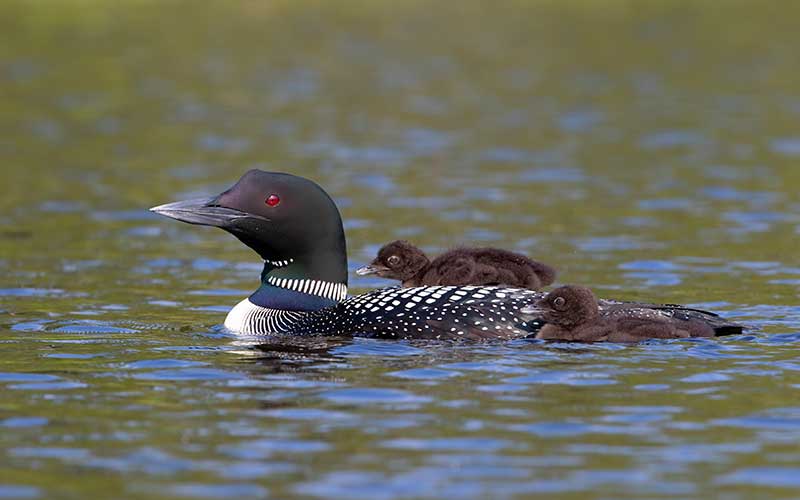
In breeding plumage, great northern divers have a black back and scapulars with heavy white spots. The upperwing is black with fine white spots except for the flight feathers. The tail is black and the underparts are white.
The head is black with a green gloss and there is a fine black and white line between the chin and throat, and two conspicuous white patches with fine vertical bars on the sides of the neck. The straight bill is black, the eyes are deep red, and the legs and webbed feet are black. Males and females are similar although the male is larger.
Out of breeding season, great northern divers have brownish-grey upperparts with a dark crown and nape. The underparts are white and the tail is dark grey.
Juveniles look like adults in non-breeding plumage with some buffy scales on the upperparts.
Try our interactive bird identifier
Great northern divers are monogamous and solitary nesters. They breed in forest lakes and ponds on a pile of vegetation near deep water.
Great northern divers lay 1-3 olive green or dark brown eggs with darker spots, which are incubated for 24-25 days mainly by the female. Chicks are covered in brown down. The larger chick receives most of the food brought by the parents and the smaller chick usually dies after a few days. They can swim and dive soon after hatching but will often rest on the adults’ backs. They fledge at 70-77 days and reach sexual maturity at 2 years.
Great northern divers eat mainly fish, as well as crustaceans, molluscs, aquatic insects, and amphibians. They will also eat plant matter including pondweeds, willow shoots, seeds, moss, and algae.
Great northern divers can be seen in the UK between August and May. They can be spotted around the coast and occasionally inland on reservoirs.
Britain's Birds
RSPB Handbook Of British Birds
Collins Bird Guide
Until the 18th century, the great northern diver was eaten in Scotland. The thick layer of fat beneath its skin was used as a cure for sciatica.