Breeding birds: 1-2 pairs
Wintering birds: 910 birds
Family: Sandpipers & allies
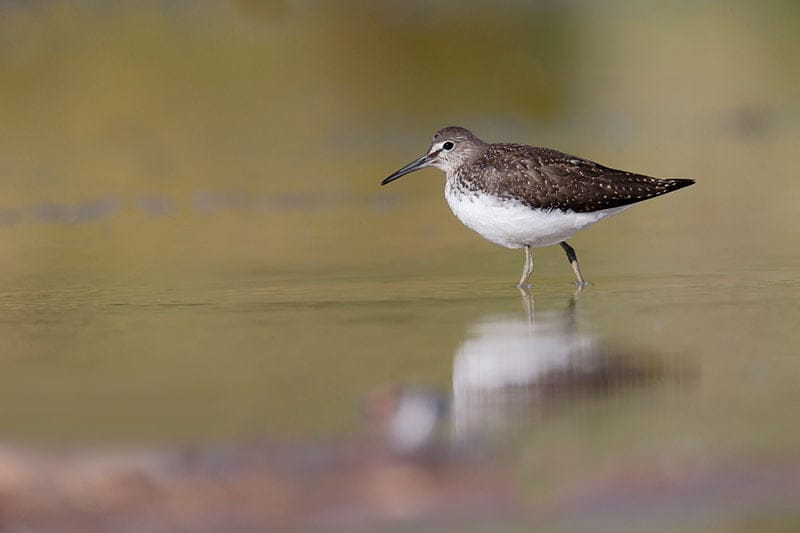
In breeding season, green sandpipers have a dark olive-brown upper mantle and wing coverts with small pale buff spots. On the scapulars and tertials the spots are larger. The rump and tail are white with broad black bars on the tail.
The upper breast is white with dark brown streaks, which merge into blotches on the lower breast and flanks. On the underwing, the coverts and axillaries are dark brown with narrow white bars. The belly is white.
On the head the chin, throat , crown, and hindneck are white with dark brown streaks. There is a conspicuous white supercilium in front of the eye, and a dark line across the lores. The straight bill has an olive-green base and black tip, the eyes are dark brown with a narrow white eye-ring, and the legs and feet are dark grey-green. Males and females are similar but the female is slightly larger than the male.
In non-breeding season, green sandpipers are paler with a grey-brown head and breast with darker streaking. The spots on the scapulars and tertials are smaller.
Juvenile green sandpipers look like non-breeding plumage with browner upperparts and breast and small buff spots on the scapulars and tertials. The breast lacks the streaks ands spots.
Try our interactive bird identifier
Green sandpipers breed between late April and July and produce 1 brood a season. It nests in trees in swampy forests and, wooded areas, using the old nests of other species of birds, such as fieldfares, or a squirrel’s drey.
Green sandpipers lay 2-4 cream, grey, or pale olive eggs with brown or reddish markings which are incubated mainly by the female for 20-23 days. Chicks are covered in dull grey down with darker markings and a dark line across the crown. Chicks jump to the ground to leave the nest soon after hatching, and fledge 28 days after hatching.
Green sandpipers eat mainly insects, as well as crustaceans, small fish, and some vegetation. They forage by pecking prey from the surface of water. They usually feed along but will sometimes gather in scattered groups of up to 50 birds.
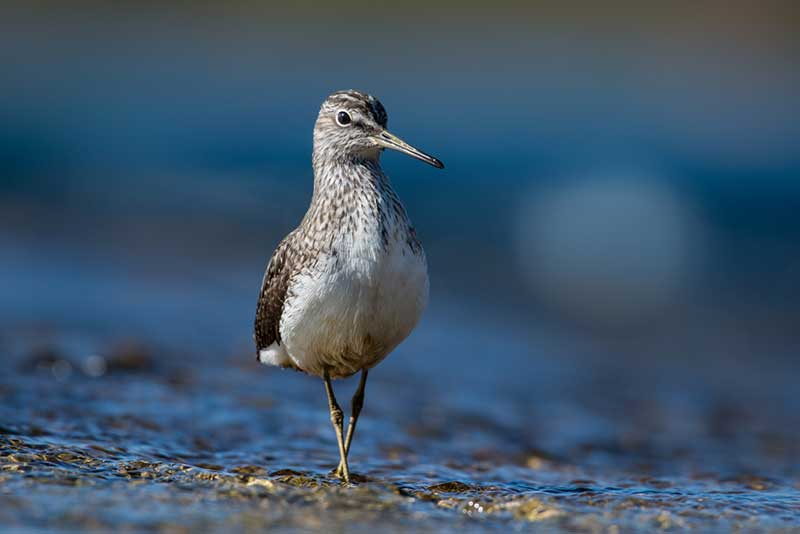
Green sandpipers can be seen all year round in England and Wales but mainly between July and March. Look out for them near freshwater such as marshes, gravel pits, and rivers. In winter they can also be spotted near sewage works and watercress beds.
Britain's Birds
RSPB Handbook Of British Birds
Collins Bird Guide
Green sandpipers are part of an ancient lineage of the genus Tringa and its only living relative is the solitary sandpiper. Both species nest in trees unlike most other waders and shorebirds.