Breeding birds: 130,000 pairs
Family: Reed warblers
Reed warblers have a warm olive-brown back and mantle with a reddish-brown rump. The underparts are pale buff or white, and the tail is brown above and paler below. The wings are dark grey with olive-brown edges to the feathers.
On the head, the crown, forehead, and nape are olive-brown and the throat is white. The lores are buff and there is a black line through the eye. The bill is dark grey above and orange-yellow below, the eyes are dark brown with a broken, pale eye-ring, and the legs and feet are dull green.
Try our interactive bird identifier
Reed warblers breed from May to July. They are monogamous and produce one or two broods a season. They nest in reedbeds and scrubby vegetation and bushes near water. The female builds the nest alone which is deep cup made from plant material, reeds, and spider webs lined with hair, feathers, and wool.
Reed warblers lay 3-5 smooth, glossy, white or pale green eggs with olive-brown speckles, spots, and blotches which are incubated by both parents for 12-14 days. Both parents care for the chicks which fledge 10-13 days after hatching.
Reed warblers are commonly brood parasitized by the cuckoo, although they will reject the egg in about 20% of cases.
Reed warblers eat mainly insects as well as spiders and snails. They will also supplement their diet with berries in autumn.
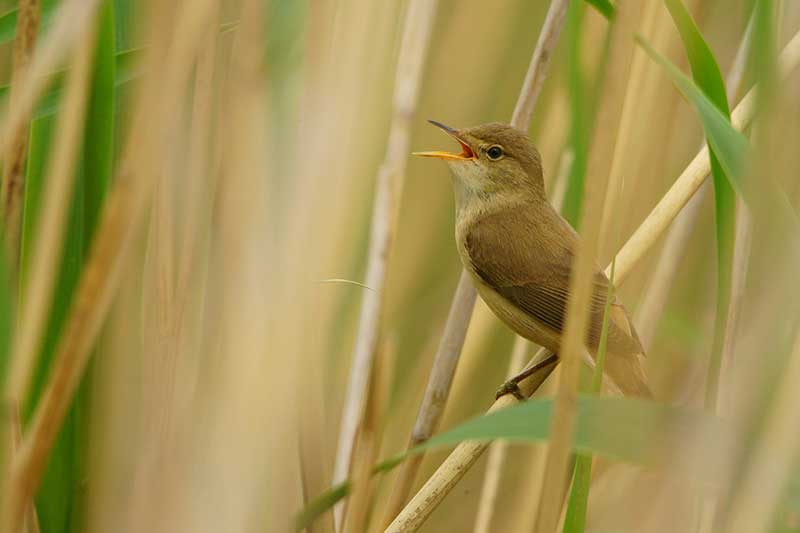
Reed warblers can be found in the UK from the middle of April to early October. Look out for them in reedbeds in lowland central and southern England and Wales. They are hard to spot and can often be heard rather than seen.
Britain's Birds
RSPB Handbook Of British Birds
Collins Bird Guide
Scirpaceus in the reed warbler’s scientific name is Latin for reed.