UK passage: 280 birds
Family: Woodpeckers
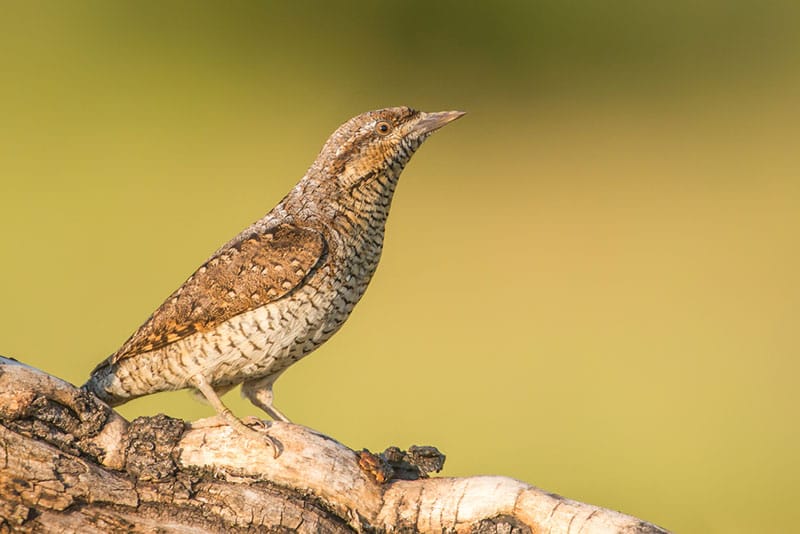
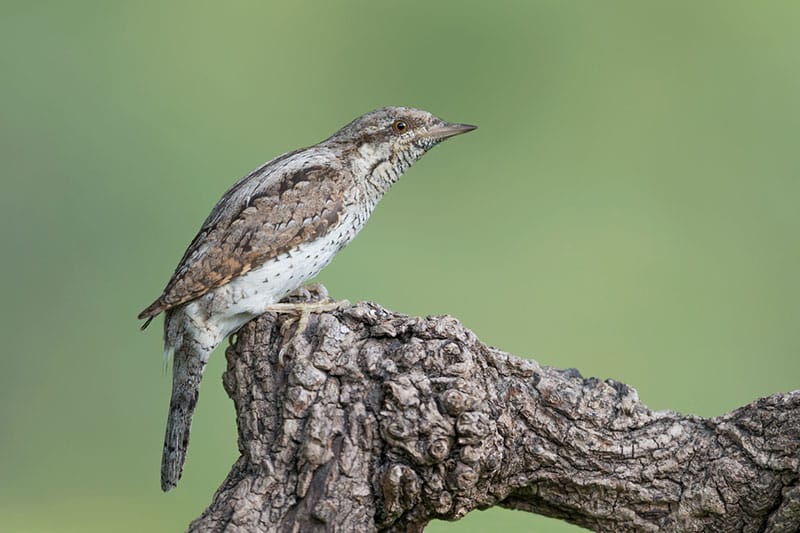
Wrynecks have highly camouflaged plumage. They have barred and mottled grey and brown upperparts with rufous and black bars and streaks. Their rumps and uppertail coverts are grey with brown speckles and bars. They have creamy white underparts with brown arrow-shaped markings which become spots on their lower breasts and bellies.
Their flanks are buff with brown streaks and their undertail coverts are buff with narrow brown bars. The square tail is grey with brown speckles and darker grey and darker brown bands. Their primaries and secondaries are brown with lighter reddish-brown markings.
Wrynecks have pale grey heads with a dark line on the crown that extends to the middle of the back. Their cheeks and throat are yellowy-brown with brown bars. They have long, slender brown beaks, hazel eyes, and light brown legs and feet. The first and fourth toes point backwards to help them cling to vertical surfaces. Males and females look similar.
Juvenile wrynecks resemble adults, but the dark eye stripe is less obvious, they have a reddish beak, dull yellow eyes, and grey legs and feet.
Try our interactive bird identifier
Wrynecks build their nests in natural cavities such as a hole in a tree or a crevice in a wall, as well as old nests and nest boxes. They will sometimes evict birds, eggs and nestlings. They use no nesting material.
Wrynecks lay 7-10 dull white, partially opaque eggs which are incubated mainly by the female for 11-14 days. Both parents feed the chicks until they fledge at about 20 days.
Wrynecks eat mostly ants, but will also take beetles, moths, spiders, and woodlice.
Wrynecks can be seen in the UK during spring or autumn. They are found around the southern and eastern coasts and will occasionally venture into gardens in autumn.
Britain's Birds
RSPB Handbook Of British Birds
Collins Bird Guide
Wrynecks have various nicknames, including twister, writhe neck, and snake bird, due to their ability to rotate their head through almost 360 degrees, and because when they are disturbed they will hiss like a snake.