With rugged coastlines, ancient woodlands, and beautiful rivers and estuaries, Cornwall has a diverse range of habitats that support a wide variety of birds, making it a paradise for bird watchers.
Jutting out into the Atlantic Ocean, Land’s End is the most westerly point of mainland England and a famous hotspot for rare birds passing by on migration. In recent years, bird watchers have been rewarded with sightings of the Dalmatian pelican, the grey catbird, the American golden plover, and the dusky warbler.
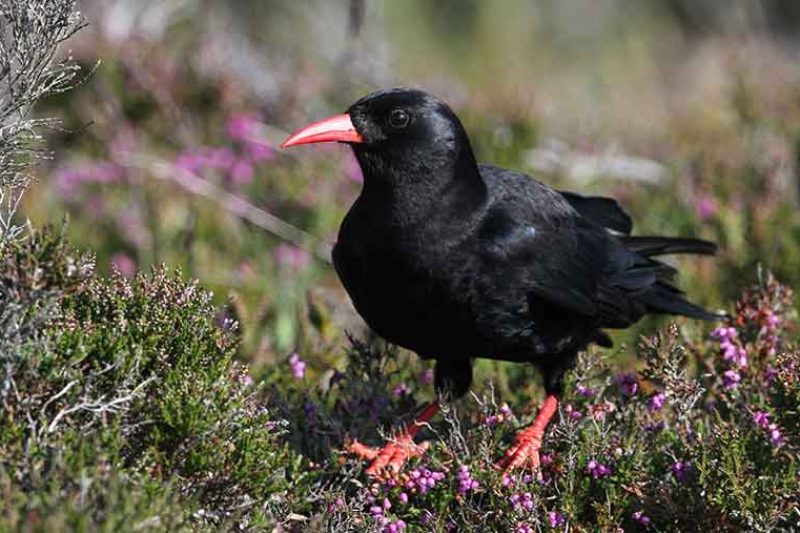
The cliffs of Land’s End are renowned for colonies of seabirds, including gannets, fulmars, kittiwakes, and guillemots. Ravens, peregrine falcons, and Cornish choughs can also be seen swooping over the tops of the cliffs.
On the beach at the bottom of the cliffs, look out for flocks of whimbrels, lesser black backed gulls, sandwich terns, sanderlings, and ringed plovers, while the surrounding grass and scrubland is home to wheatears, stonechats, and linnets.
Just off the coast of Padstow, is Cornwall’s only breeding puffin colony. Although, it’s not possible to visit ‘Puffin Island’, there are regular boat trips that sail past the island so you can get a close up view of these comical birds. On the way you’ll sail past other seabirds such as shearwaters, terns, grebes, cormorants, fulmars, and gannets, as well as plenty of marine life including dolphins, whales, porpoises, and occasionally basking sharks.
Surrounded by sea on three sides and the Helford River to the north, the Lizard Peninsula is one of the most important breeding sites for the chough. For many years, it was largely absent from the county, but started breeding again in 2002 thanks to efforts from local conservationists.
Windmill Farm, located just a mile north of Lizard village, and managed by the Cornwall Wildlife Trust has important heathland habitats, pools, and scrapes that in spring are home to numerous warblers, including whitethroats, reed warblers, sedge warblers, and willow warblers. The site, once a dairy farm, is also a good place to listen out for cuckoos calling.
Check out these places to stay nearby
The wild, rugged upland landscapes of Bodmin Moor are internationally important for their rich variety of wildlife, particularly bird species. Reed buntings, wheatears, skylarks, and grasshopper warblers all make their homes among the dry heath and scrubland, filling the air in spring with their beautiful songs. Along the streams and rivers, keep an eye out for dippers and wagtails, while in the woods you may spot marsh tits, willow tits, tree pipits, redpolls, and siskins.
In autumn and winter, large flocks of golden plovers, lapwings, snipes, and jack snipes gather across the moor, with Rough Tor and Brown Willy being among the best places to see them. This season is also ideal for spotting birds of prey, including short-eared owls, merlins, peregrine falcons, and hen harriers.
Located about eight miles southwest of Bodmin, Goss Moor National Nature Reserve is a complex mix of wet and dry peatland and lowland heath. Historically, much of the area was used for tin streaming, a method of extracting tin using streams and rivers, which, over hundreds of years, altered the landscape and affected the ecological balance by changing landforms and contaminating watercourses. In recent decades, the moor has undergone significant restoration and is now recognised as an ecologically important site. Together with its neighbouring Tregoss Moor, it forms part of a Site of Special Scientific Interest (SSSI) and a Special Area of Conservation.
During the summer months, ravens are a common sight, and the reserve offers a good chance of spotting willow warblers, grasshopper warblers, spotted flycatchers, and the increasingly rare nightjar. In winter, great grey shrikes are a strong possibility, alongside birds of prey such as kestrels, merlins, and hobbies.
Goss Moor is also home to a variety of rare plants, as well as numerous species of damselflies, moths, and butterflies.
Covering the tidal estuaries of the Rivers Tamar and Tavy, on the border between Cornwall and Devon, this area has been designated a Site of Special Scientific Interest. Its mudflats, saltmarshes, grasslands, and rocky shorelines are of international importance for wildlife.
Each winter, more than 20% of the British population of avocets arrives here, along with other wading birds such as black-tailed godwits, green sandpipers, whimbrels, and dunlins. Herons, little egrets, and oystercatchers can be seen throughout the year, while rarer visitors like spoonbills and red-breasted mergansers occasionally make an appearance.
Bird watching cruises are available on the estuary, with local guides offering expert knowledge helping you to improve your bird identification skills.
The Hayle Estuary nature reserve, managed by the RSPB, is a wetland area with tidal pools and marshes. One of the few natural harbours on the north coast of Cornwall, it has been designated a Site of Special Scientific Interest. During spring and autumn, migrating gulls and terns pass by, while in winter up to 18,000 wintering waterfowl arrive.
With various nature trails throughout the site as well as viewing platforms and hides, it’s an ideal place for a quiet day’s bird watching.
Also managed by the RSPB, Marazion Marsh is Cornwall’s largest reedbed. Lying in the shadow of St Michael’s Mount, the reserve is made up of wetlands, willow scrub, and grassland, and is an important wintering spot for bitterns. A pair of Cetti’s warblers have been known to breed here, as do herons, little egrets, and chiffchaffs. The site is also one of the few places in the UK to spot the globally threatened aquatic warbler.
Millions of starlings arrive to roost in autumn entertaining visitors with their dazzling murmurations to avoid birds of prey such as buzzards, peregrine falcons, and sparrowhawks who begin hunting at dusk.