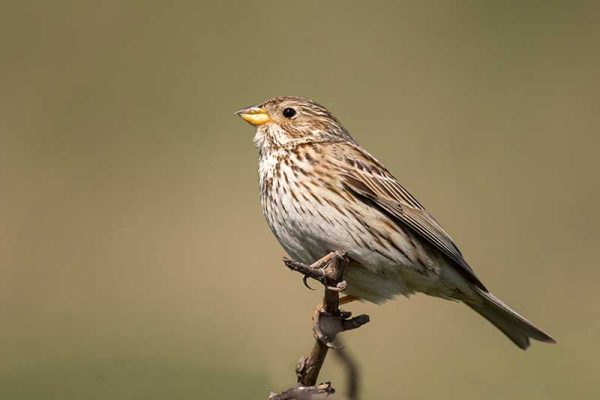
The house sparrow is a small, stocky, finch-like bird and one of the most recognisable species in Britain. Highly social, it is often seen in large, noisy family groups and was once so common in London that it earned the nickname “Cockney Sparrow”.
However, its numbers in the capital have sharply declined in recent years, primarily due to high chick mortality caused by a shortage of insects needed for food. Research suggests that supplementary feeding with mealworms can significantly improve nesting success and support population recovery.
Breeding pairs: 5,300,000
Family: Old World Sparrows
The adult male house sparrow has rich chestnut upperparts with black streaks on the back and scapulars. Its flight feathers are brown with darker brown edges, and the upperwing has a prominent white wing bar. The tail is dark brown, and the rump is grey. Its underparts are grey with a distinctive black chin and bib.
The head has a grey crown and nape, bordered by a chestnut stripe that runs from behind the eye, through the ear coverts, and along the sides of the neck. The cheeks are pale grey and the lores are black. The conical bill is black, the eyes are dark brown, and the legs and feet are pinkish.
The female house sparrow is much duller in appearance, with brown plumage streaked with black on the upperparts and greyish underparts. She lacks the black bib and distinct head pattern of the male, and her crown is brown. A pale buff eyebrow is present, and her bill is yellow.
Outside the breeding season, males appear duller, with a smaller black bib and a paler bill.
Juvenile house sparrows resemble adult females in their plumage.
Try our interactive bird identifier
The house sparrow begins breeding as early as January and may continue until July, producing 2 to 4 broods per season. It is monogamous, often forming lifelong pair bonds. Breeding typically occurs near populated areas such as towns, villages, and farms, and nests are sometimes found in unconventional locations, including lofts, the backs of road signs or billboards, as well as in natural crevices, holes, and cavities. Both the male and female contribute to nest building, using materials such as dry grasses, straw, twigs, plant matter, feathers, string, paper, and other debris.
House sparrows lay 3 to 5 pale blue or green eggs marked with darker grey, brown, or purple spots. The eggs are incubated primarily by the female for 10 to 14 days, although the male may take over if the female is away feeding. The chicks are altricial and are fed by both parents with regurgitated insects. They fledge approximately 2 weeks after hatching and become independent by 28 days, reaching sexual maturity at one year.
House sparrows have a diverse diet, primarily consisting of grains, seeds, fruits, insects, worms, and spiders in rural areas. In urban environments, they are more opportunistic, readily consuming discarded food. They frequently visit gardens, where they feed on bird food and kitchen scraps, often displaying aggressive behaviour and dominating at feeders.
They usually forage on the ground, sometimes gathering in large, noisy groups, particularly during the winter. They also forage in trees and shrubs and occasionally catch insects mid-flight from a low perch.
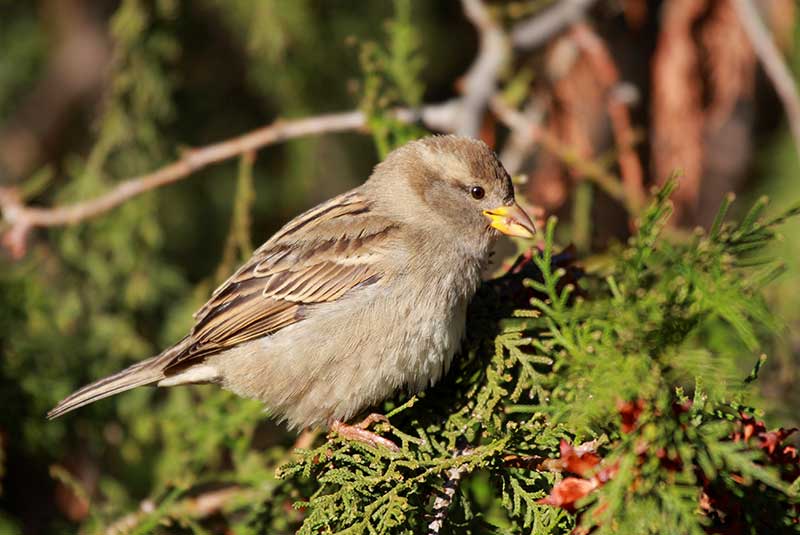
House sparrows can be seen all year round across the whole of the UK. Although they are declining from the centres of many cities they are still common in most towns and villages.
Britain's Birds
RSPB Handbook Of British Birds
Collins Bird Guide
House sparrows have coexisted with humans for at least 10,000 years. However, they are often regarded as pests due to their tendency to feed on agricultural crops.
In the early 20th century, sparrow clubs were established to control their population, culling millions of birds and destroying their eggs. Despite these efforts, the overall sparrow population remained largely unaffected.