


Breeding birds: 17,000 – 20,000 pairs
Family: Old World Flycatchers
Male pied flycatchers’ breeding plumage is black and white. They have glossy black upper parts, with white underparts including the chin, neck and throat.
Their flight feathers are dark brown with a large white patch. The tail is black with white edges. There is a small white patch on the forehead.
Pied flycatchers have black bills, dark brown eyes and black legs and feet.
Females have similar markings but are much paler and the patch on the head is absent. Juvenile pied flycatchers are similar to females but they have pale spots on their upperparts.
Try our interactive bird identifier
Pied flycatchers nest in tree holes with small entrances. The male will arrive at the breeding ground first to find a suitable location and will defend a small area around the nest before attracting a female with his call.
Female pied flycatchers build the nests. They are loose cups constructed from dead leaves, moss and roots and lined with fine grasses, hair and feathers.
Pied flycatchers lay 4-10 smooth, glossy, pale blue eggs which are incubated by the female alone for 13-15 days. Both parents feed the chicks which fledge at 14-18 days.
Pied flycatchers eat various insects including mayflies, dragonflies, grasshoppers, spiders and beetles. They will catch insects flying in the air as well as from the ground. They will also supplement their diet with seeds, berries and fruit.
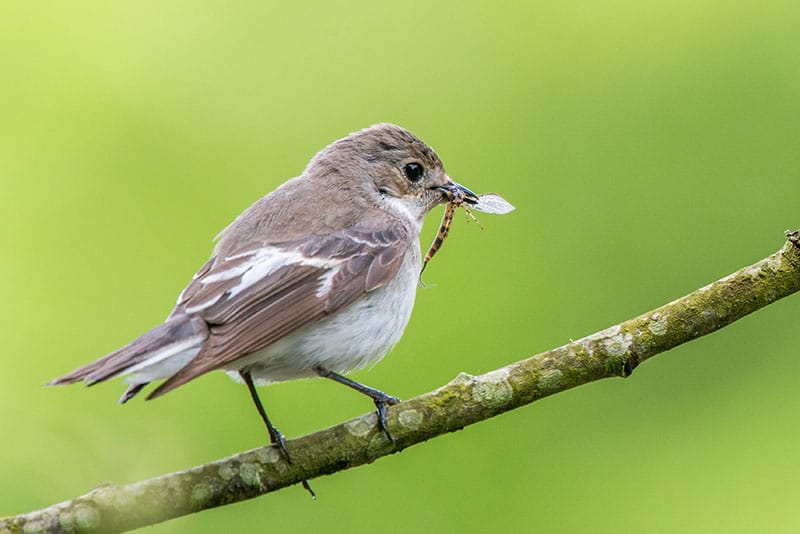
Pied flycatchers are summer visitors arriving in late April and staying until September. They can be found in mature woodlands in the west of the UK particularly in the valleys and hillsides of Wales.
Britain's Birds
RSPB Handbook Of British Birds
Collins Bird Guide
Male pied flycatchers are known to practice bigamy rearing chicks with a second mate, and sometimes travelling great distances between the two nest sites.






One Response
Male pied flycatcher seen today at Culverstone, Kent! Heavily wooded area.