

Breeding birds: 32-51 pairs
UK wintering birds: 130 birds
Family: Grebes
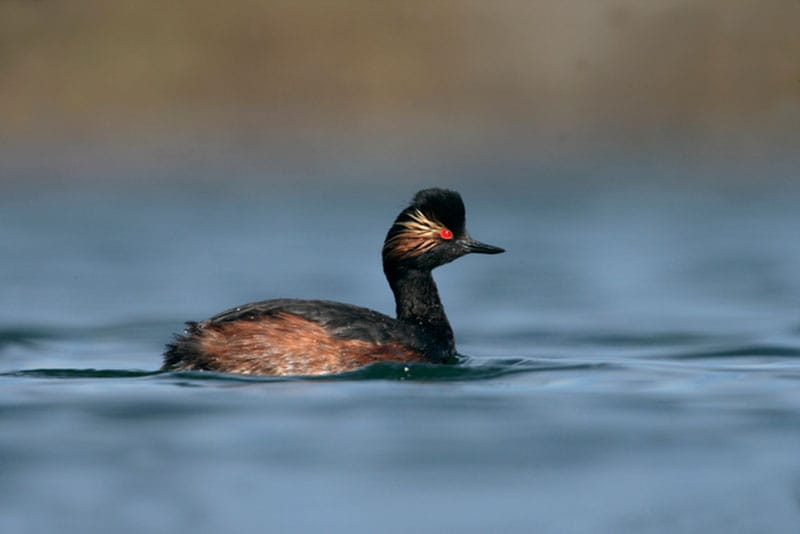
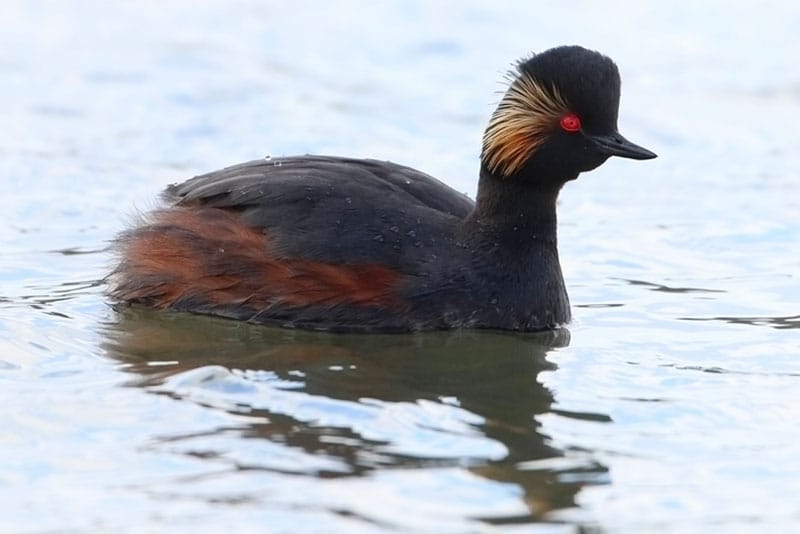
In breeding plumage black-necked grebes have blackish-brown breasts and upperparts with white patches on their upperwings. Their flanks are rufous or chestnut with black flecks and their underwings and underparts are white. They have black or dark brown heads and necks although the foreneck can sometimes be tinged with lighter brown. There is a distinctive ochre-coloured fan of feathers that extends behind the eye towards the sides of the nape.
Black-necked grebes have black thin, upturned bills, and red eyes with an orange-yellow orbital ring. Their legs and feet are dark greenish-grey. Males and females are similar.
In non-breeding plumage black-necked grebes have dark grey upperparts, and white breasts and underparts. Their flanks are blackish-grey with white flecks.
They have a dark-grey nape and hindneck with a paler grey face. The crown is dark grey extending below the eye and diffused to the ear-coverts. Their bills are greyer than in breeding plumage.
Juvenile black-necked grebes are similar to non-breeding adults. The dark areas are more brown and their lores are tinged with pale grey with white marks behind their eyes. They have a buff wash on the sides of the head and upper neck.
Try our interactive bird identifier
Black-necked grebes breed in colonies or in single pairs between April and August. Both sexes build a cup-shaped floating nest made from vegetation that is mostly submerged and anchored by plants.
Black-necked grebes lay 3-4 chalky green or bluish eggs that are incubated by both parents for 21 days. After the chicks have hatched black-necked grebes will desert the nest and the chicks live on the parents backs for about 4 days. After about 10 days the parents will split the chicks up with each parent taking care of half of the brood. They are independent after another 10 days and fledge in about 3 weeks.
Black-necked grebes eat insects, crustaceans, molluscs, tadpoles, and small frogs and fish. When moulting on high-saline lakes they will eat mostly brine shrimp.
Black-necked grebes can be seen all year round in the UK but are best looked for in winter. The can be found in reservoirs, gravel pits, and estuaries, particularly in the South and the West Country.
Britain's Birds
RSPB Handbook Of British Birds
Collins Bird Guide
Black-necked grebes cannot walk very well and generally avoid flying for about 9 months of the year. After moulting it is unable to fly for 2 months and its breast muscles atrophy. It can almost double in weight during this period, using the additional fat to help power its migration to wintering grounds which can cover up to 6,000 km.




One Response
We have small pond, i believe we have a grebe. It is small with beige feathers around eye. Has red eyes from what i can tell. Doesn’t walk well , but dives and swims fine. He or she has been here 2 days.