Breeding birds: 1,000 pairs
Family: Old World Buntings
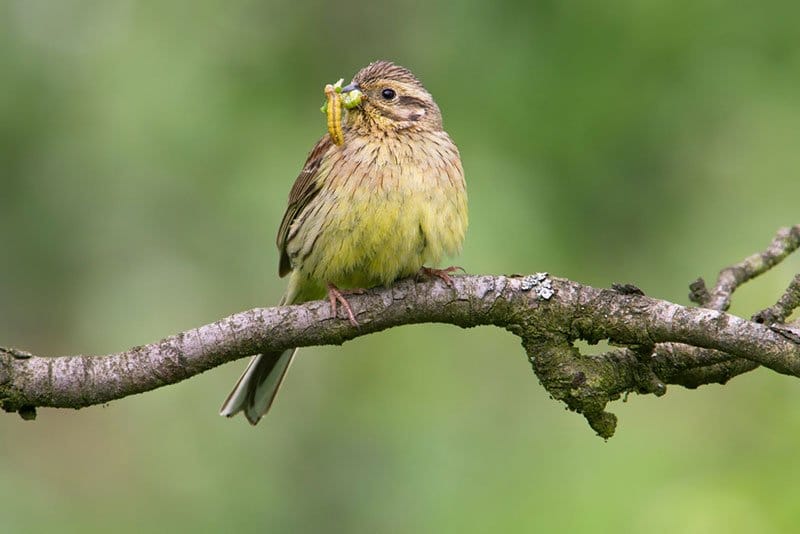
Adult male cirl buntings in breeding plumage have olive, grey, and brown upperparts streaked with black. The underparts are yellow with a greenish-grey band and rusty-brown patches on the breast, and fine dark streaks on the flanks. The upper tail is brown with white outer rectrices and the undertail is grey.
On the head, the face is yellow with a dark stripe through the eye, the nape is olive-brown, and the crown and throat are black. The conical shaped bill is black, the eyes are dark brown, and the legs and feet are pinkish-brown.
Out of breeding plumage cirl buntings are duller overall and the head is more streaked.
Female cirl buntings are similar to male cirl buntings in winter plumage but they have more streaks on the underparts, a yellow throat and no marks on the head.
Juveniles resemble adults but have no yellow, and have paler brown and white underparts with more streaks.
Try our interactive bird identifier
Cirl buntings are monogamous and breed from April to mid-September. They build their nests on the ground hidden in dense vegetation such as scrubs and hedgerows. The nest, built by the female, is a bulky cup made from grass, moss, roots, and leaves, and lined with fine stems, rootlets, and hair.
Cirl buntings lay 2-5 smooth, glossy white or pale green eggs with purple, grey, or black speckles and streaks that are incubated by the female alone for 11-14 days. The chicks are fed by both parents and fledge 12-13 days after hatching. Cirl buntings may produce up to 3 broods a season .
In the summer Cirl buntings eat mainly invertebrates including beetles, moths, caterpillars, flies, aphids, and spiders. In the winter they switch to a diet that consists mostly of seeds.
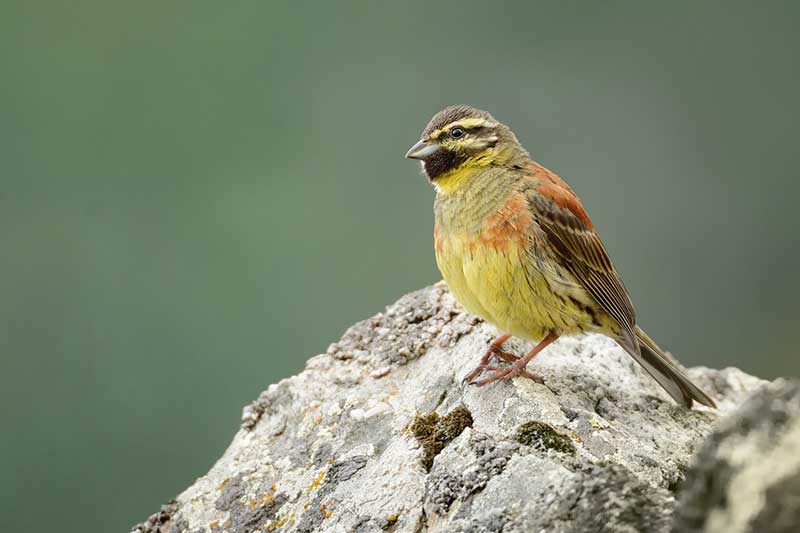
Cirl buntings can be seen all year round but are found only in south-west England. Look out for them in fields and hedges near to the coast of Devon.
Britain's Birds
RSPB Handbook Of British Birds
Collins Bird Guide
Cirl buntings were introduced to New Zealand from the UK in the late 19th century. The population has not spread and it is mainly confined to the north of South Island.