

UK breeding birds: 1,900 pairs
Family: Gulls, Terns, And Skimmers
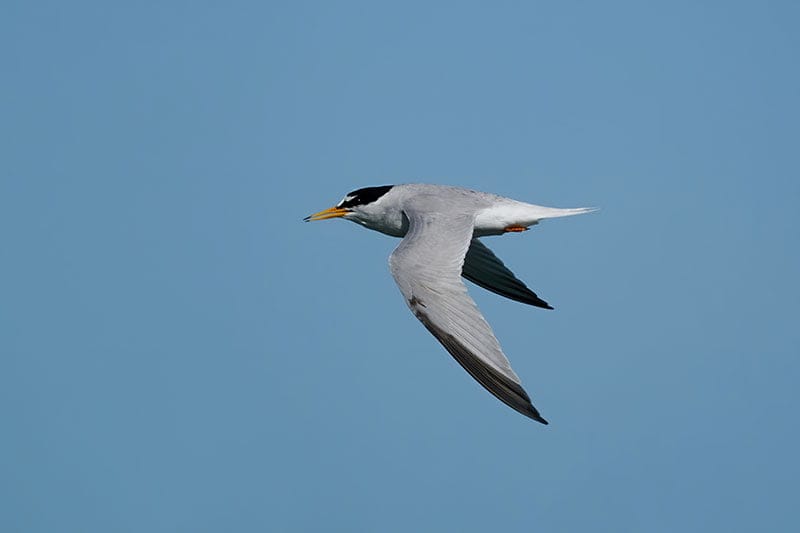
In breeding plumage, adult little terns have a grey back and upperwing, and white underparts, rump, and forked tail. The outer primaries are black.
On the head, the crown, and lores are black, and the forehead, sides of the head, and throat are white. The long, thin bill is bright yellow with a black tip, the eyes are dark brown, and the legs and feet are yellow or orange. Males and females are similar.
Out of breeding plumage, little terns have pale streaks on the front of the crown, white lores, and a black spot in front of the eye. The lesser coverts are dark, and the bill and legs and feet are black.
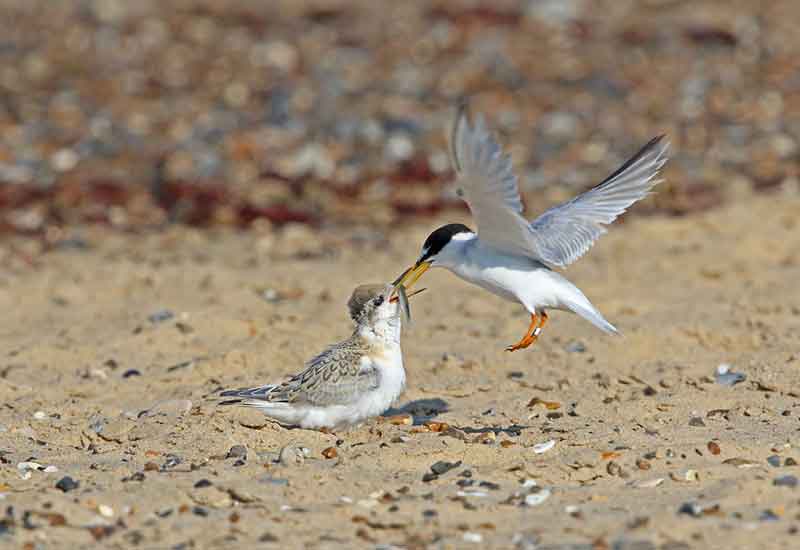
Juvenile little terns are white overall with black edges to the mantle feathers, and dark wing-coverts and outer primaries. By its first winter it resembles adults in non-breeding plumage.
Try our interactive bird identifier
Little terns breed from April in small colonies of no more than 100 pairs. The nest is situated near water and is a shallow scrape in the ground in sand, shingle, coral, or rock, usually above the high-tide line. In marshy areas, they may build a platform of vegetation or shells.
Little terns lay 2-3 smooth, pale olive or cream-coloured eggs with grey and brown speckles and blotches. Both sexes incubate the eggs for 21-24 days. Chicks are covered in pale grey and white down and are fed by both parents for about 2 months. They fledge at 2-24 days after hatching and are sexually mature at 2-3 years.
Little terns feed mainly on small fish and crustaceans, as well as aquatic insects and molluscs. They forage by hovering over water in search of prey and then plunge-diving to catch it.
Little terns can be seen in the UK from April to September. They can be found around the coast particularly on the east and south coasts of Scotland and England.
Britain's Birds
RSPB Handbook Of British Birds

Collins Bird Guide
In 2014 a little tern was found dead at Blakeney in Norfolk, having been ringed as a chick 21 years previously. The bird had an egg inside here so was still of breeding age.


