One of the ways we’re able to keep Bird Spot going is from commission we earn from the Amazon affiliate programme. What this means is, that whenever someone clicks on a product we have recommended and buys it on Amazon, we get paid a small percentage of the sale price. It’s not much, but it keeps the lights on.
But something we quite often roll our eyes at is just how wrong many of the illustrations are to accompany the products that we pick. We’re not talking about badly drawn birds – in fact most of the details are pretty spot on – but whoever is putting the pictures together clearly has no idea what birds live where.
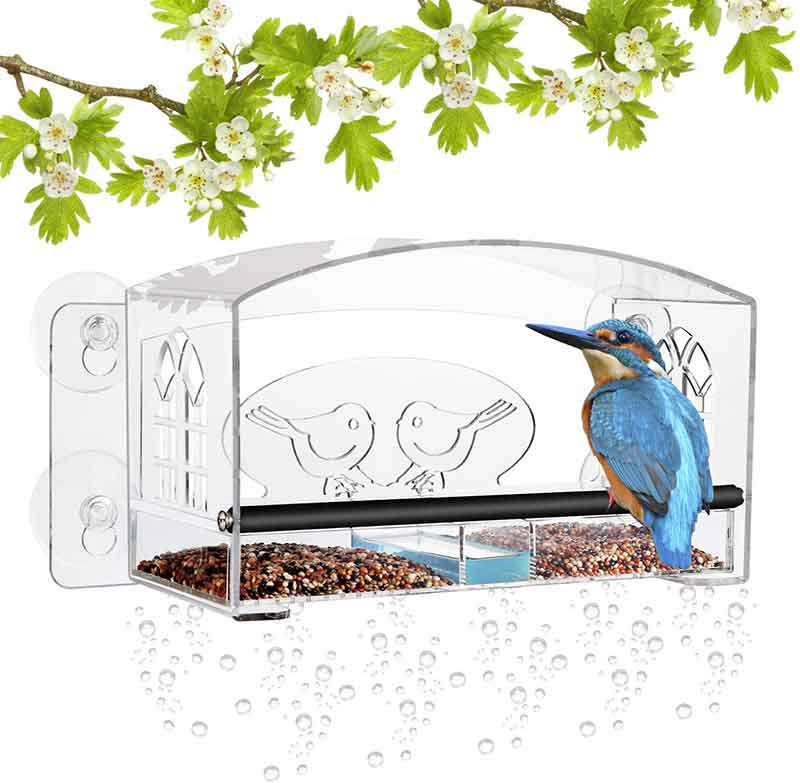
Kingfisher at a window bird feeder
The chances of seeing a kingfisher in your garden let alone have one land on a bird feeder to eat seeds is slim. Kingfishers are not typically garden birds. They tend to be very shy and you’re most likely to spot them as they fly low over streams and rivers as a brilliant flash of blue, or when they’re sitting on a perch bobbing their heads as they scan the water for a passing fish.
Kingfishers don’t generally eat seeds either. They are primarily fish eaters although will supplement their diet with aquatic insects which they catch in flight.

Bee-eater, bullfinch, great tit, and macaw at a seed feeder
Let’s talk about the bee-eater first. As the name suggests the species feeds primarily on stinging insects as well as butterflies, grasshoppers, and termites, and is very unlikely to visit a bird feeder.
OK, so perhaps it hasn’t joined the bullfinch and great tit to feed, but is simply flying past in pursuit of a bee. Even so, it’s not going to be found sharing a bird feeder with a blue-and-yellow macaw. These parrots, also known as blue-and-gold macaws, are native to South America and although a few feral populations have established themselves outside of their range none are found living wild in Europe.
The other major mistake in the depiction of the macaw is its size. It measures about 80 cm in length so should be about 5 times the size of the bullfinch perched opposite it.

Barbet, tanager, parakeet, and robin at a bird feeder
Where to start. Here we have clockwise from bottom left, a blue-throated barbet, a flame-coloured tanager, (possibly) a sun parakeet, and a European robin.
The blue-throated barbet is native to the Indian subcontinent and Southeast Asia. It has a heavy bill that evolved to eat fruits and insects, not seeds, and can be found in tropical forests, gardens, orchards, and cities with fruit trees.
The flame-coloured tanager is found in the Americas from Mexico to northern Panama, and occasionally the United States. It inhabits humid montane forests, as well as non-forested areas with large trees such as coffee plantations and gardens. Like the barbet is eats insects and fruit and does not have a bill that can deal with seeds.
The badly drawn sun parakeet, or sun conure, is native to a small region of South America and found in tropical habitats such as humid forests and palm groves. They are popular as pets due to their brightly coloured plumage and ability to learn tricks, such as singing and dancing. They have a varied diet which includes fruit, flowers, berries, seeds, nuts, and insects.
The robin is a European bird that is only found as far south as Iran. Attempts to introduce the robin into North America failed after the bird was released in Long Island, New York, and Oregon in the 19th century. A robin will eat seeds, and is often found at bird feeders, but never alongside the 3 tropical birds it’s shown with in this illustration.

Blue jay, hummingbird, zebra finch, and kingfisher at a bird feeder
Another shocker. At this seed feeder we see the aforementioned kingfisher, a bird native to Europe, Asia, and North Africa. Hovering above it is a zebra finch, found in Central Australia, although at least this species does eat seeds. Opposite is some sort of hummingbird, possibly a female ruby-throated hummingbird, but in all likelihood a species made up in the illustrator’s imagination. And finally, on the bottom left of the picture, we have a blue jay, a member of the corvid family found in eastern North America.
None of these species would ever be seen together on a bird feeder but we are quite taken by the huge hummingbird. It’s about twice the size of the kingfisher which has an average length of 14 cm. This would make it even larger than the giant hummingbird, the largest hummingbird in the world, which measures about 23 cm long. All other species of hummingbird in the world are less than half this size.
And that massive bird feeder? If like us you have a problem with your garden birds eating you out of house and home then maybe it’s not such a bad idea after all.

Have you ever had a barn swallow land on your bird feeder? No, neither have we. Swallows are aerial birds and almost never visit bird feeders no matter what food you put out. They eat as they fly, catching insects in their wide-open gapes. They even drink mid-flight, flying low over water and scooping their bills over the surface.