

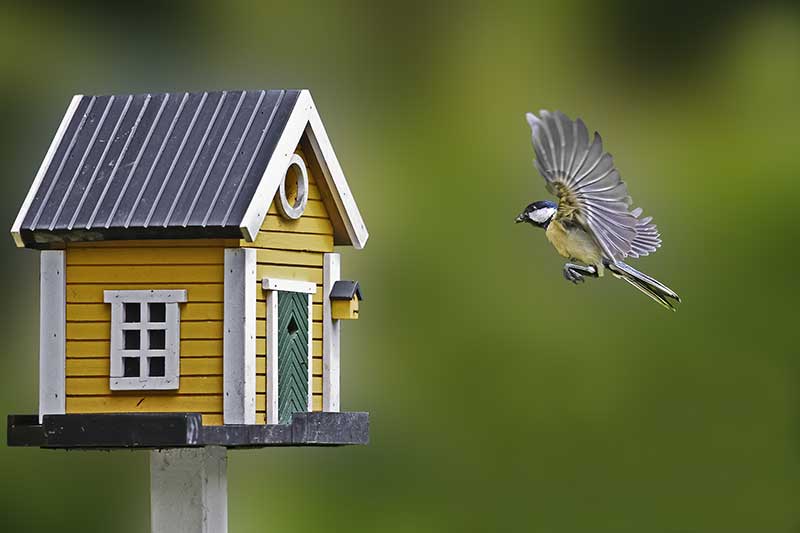
A bird flying into your home can be an unsettling experience. Even if you don’t usually suffer from ornithophobia – a fear of birds – having one flapping around in a confined space, desperately trying to escape, can be nerve-wracking.
For many, this experience comes with an extra layer of anxiety, as the event is steeped in spiritual meanings and superstitions, not all of which are positive.
One of the most persistent superstitions is that a bird entering your house foretells bad luck or even an impending death. This belief is especially common in Celtic traditions, where black birds like crows and ravens are often linked to sickness and mortality. The larger and more disruptive the bird, the more ominous the event seems, as their size and frantic movements can cause damage, adding to the unease.
A particularly specific superstition warns that if a bird flies into a house, circles a room, and lands on the back of a chair, the person who usually sits in that chair is next to face the grim reaper, while in Ireland, the presence of a wild bird inside the home is said to signify the illness or death of a woman in the family. However, there’s no statistical evidence to support either of these claims.
Even a bird attempting to enter your home or tapping on a window can be interpreted as a warning of doom. For some, the mere sight of a bird colliding with a window is seen as a sign of imminent family loss. While this may be true for the unfortunate bird itself, it’s worth questioning whether these superstitions hold any real merit.
Because of these beliefs, some people go to great lengths to avoid anything bird-related in their homes. They may refuse to keep pet birds, hang paintings or decorations featuring birds, or even bring feathers into their living spaces, particularly peacock feathers, which are often thought to bring bad luck.
Killing a bird that enters your house is also considered taboo. Beyond being against the law in many countries, harming a bird could lead to tangible bad luck in the form of legal trouble or fines.
Even celebrities haven’t escaped these superstitions. Lucille Ball, for example, had a well-documented fear of birds, and refused to stay in hotels that displayed pictures of birds. She reportedly tore down some expensive Japanese silk wallpaper from her Beverly Hills home after noticing bird motifs in the design. Ball traced her phobia back to childhood when, shortly after her father’s death, a bird flew into her family home and became trapped.
Superstitions surrounding birds don’t stop at your home’s interior. Some believe that herons or bitterns simply flying over your house can bring bad luck. And of course, Alfred Hitchcock’s The Birds has forever linked the sight of gathering birds with ominous outcomes.
It’s not all doom and gloom, though. In many cultures, a bird entering your home is seen as a positive omen, particularly if the bird is white or brightly coloured. These birds are often associated with good luck, opportunities, protection, or harmony.
Doves and pigeons, symbols of peace worldwide, are especially welcome. And if one happens to relieve itself on you during its panicked escape, it’s considered doubly lucky.
In some traditions, birds are seen as messengers. A bird flying into your house might be trying to deliver a message, though deciphering whether it’s good or bad is up to your interpretation.
If a bird appears restless inside your home but doesn’t seem eager to leave, some believe it signifies the presence of a spirit. This isn’t always a negative sign; the spirit could be there to guide you through a challenging time.
Birds are also linked to love and romance. In Indonesia, for example, a sparrow flying into a house is thought to predict a family member’s upcoming marriage or the birth of a baby. A bird attempting to build a nest in your home is viewed as a sign of new life and prosperity.
Like many superstitions, these ideas likely stem from our ancestors’ attempts to make sense of the world before the advent of modern science. Animals’ behaviours, particularly those that crossed the boundary between the wild and the domestic, were often imbued with meaning.
Birds, with their freedom to traverse air, land, and water, were seen as particularly significant. Their presence inside a home, a space symbolically separate from nature, was interpreted as an omen, for better or worse.
Today, most of us recognise that superstitions are irrational. Still, it’s not uncommon for even the most logical among us to hold onto certain beliefs. While a bird flying into your house is almost certainly bad luck for the bird itself, any misfortune that follows is likely coincidental. Remember, correlation does not imply causation.




110 responses
Today my coworker and I were sitting at our desk when a little brown bird flew in the house and went under the desk. My coworker try to catch him but the bird kept moving around until it went into the closet. I ask one of my client to catch it and he did. My coworker bring it outside and it flew away.