Although birds can be found all over the world living in a variety of habitats, some birds have evolved to live almost exclusively in the air, on the ground, or in trees.
Apart from the few birds that can’t fly, all birds spend time in the air, but a true aerial bird lives the majority of its life in flight. Aerial birds are able to feed, drink, sleep, mate, and even sleep on the wing and have evolved to have some unique characteristics that help them remain airborne.

Aerial birds take advantage of strong wind currents and thermals to help them stay in the air. Some can stay aloft for hours, soaring with very little wing motion, while others will twist and turn about using small changes in air pressure and wind speed to keep them in the skies.
Aerial birds tend to have slender, streamlined bodies and exceptionally lightweight skeletons to help maximise aerodynamic efficiency. The wings are often long and pointed which helps create extra lift and enhanced agility. Some aerial birds have long tails or tail streamers which can help them steer better.
Studies on the barn swallow, one of the best-known aerial birds, found that long tail streamers are not only a good indication of the health of a bird and a predictor or reproductive success but also help it manoeuvre better. However, the male swallow’s streamers are on average slightly longer than the female’s which would indicate that sexual as well as natural selection has played a part in how they have evolved, although they have not yet evolved to be so long that they are a handicap in flight.
Aerial birds often have poorly developed feet which makes walking or perching difficult. Many aerial birds cling to vertical surfaces instead and some have such short legs in relation to their wings that they find it hard to take off from the ground at all. Those with better developed feet, such as albatrosses, can walk on land but look rather ungainly doing so.
Aerial birds catch their prey as their fly, a technique known as hawking. Swifts are the masters of continuous, aerial feeding, spending hours in the air, and flying high on rising air current to catch small insects. Other birds that feed in the air include swallows, martins and nightjars. Most aerial birds are carnivorous feeding mainly on insects, although some are piscivorous, landing briefly on water of diving below the surface to catch fish.
Some aerial birds drink very little and derive all their moisture from their food. Others will skim over the surface of water to take a drink and will even bathe in flight by flying slowly through falling rain.
In contrast to aerial birds, terrestrial birds spend much of their life on the ground, foraging for food such as seeds and grains, as well as nesting and sleeping. Terrestrial birds can sometimes be flightless, or they can have very short wings and bulky bodies, which makes flying difficult.

Terrestrial birds tend to have round, plump, and fairly compact bodies with round heads that can seem small in proportion to their overall size. They often have blunt, rounded wings which are incapable of long flight or any sort of acrobatics in the air. They may find it hard to manoeuvre very well and fly directly over short distances with rapid wing beats.
When they do fly, they usually stay close to the ground and will only travel a short distance, perhaps when alarmed or disturbed. Instead, they have strong, powerful legs which allow them to outrun predators although sometimes they will freeze in response to threats. The bittern, for example, a secretive bird that spends most of its time hidden amongst reed beds will point its head upwards and not move if it is threatened, its cryptic plumage blending into the vegetation around it.
To protect them from the increased risk of predation on the ground, terrestrial birds will often be heavily camouflaged particularly the female who is especially vulnerable during breeding season. Males may have bolder plumage patterns or ornaments that help them attract mates during courtship displays.
Terrestrial birds produce large broods of precocial chicks who are able to leave the nest soon after hatching to minimise the risk of predation. Parent birds may engage in distraction techniques such as feigned injuries or false brooding to keep their eggs and chicks safe from predators. They also tend to be gregarious, gathering in large flocks, with some birds standing on guard for the group.
Terrestrial birds are almost exclusively herbivores, with a diet that consists of plant matter such as grasses, seeds, and grain. For chicks, insects can be an important part of their diet to provide protein.
They prefer dust baths and sunbathing to help keep their feathers in good condition as getting wet could impede their already limited flight abilities further.
Not all flightless birds are terrestrial. Penguins, and flightless ducks and grebes, all spend more time on water than on land. They forage for food, evade predators, perform courtship displays, and even sleep on water and so even though they can’t fly are considered to be aquatic birds rather than true ground dwellers.
Arboreal birds spend most of their time in trees and dense foliage. They will perch and roost in trees as well as forage in holes and tree cavities looking for insects and seeds. They have diets that are adapted to forest environments so tend to be insectivorous or frugivorous.
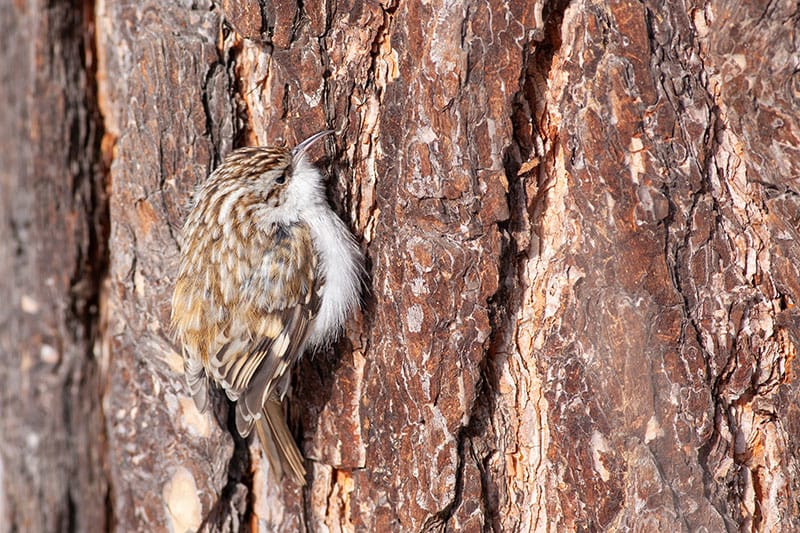
Arboreal birds can be found all over the world in a variety of habitats including tropical jungles and coniferous forests as well as orchards, parks and gardens. They tend to have patterned plumage which helps camouflage them although many are also brightly coloured which means they can be an easy target for predators. Arboreal birds have feet and claws that have evolved to grip and climb trees and some have toes that have adapted to enable them climb down as well as up, such as nuthatches.
Other examples of arboreal birds include woodpeckers, tits, warblers, treecreepers, parrots, toucans and orioles. Unfortunately arboreal birds are particularly vulnerable to habitat loss with many species reliant on certain species of trees to survive.