Family:
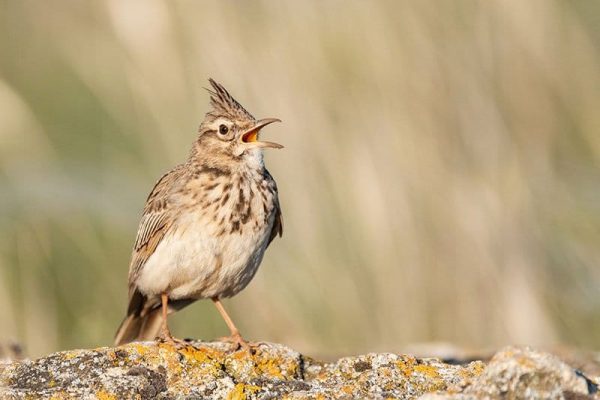
The calandra lark is a large, bulky bird with a strong, thick, conical bill. Its upperparts are grey-brown with dark streaks, and its tail feathers have white edges. The underparts are predominantly white, with a pale buff upper breast streaked with brown, and black patches on the sides of the neck. Its head is brown, with a darker crown, white chin and throat, and a distinct pale stripe above the eye. The bill has a dark upper mandible and a yellow lower mandible, the eyes are brown, and the legs and feet are brown.
Males and females are similar, but the female has less conspicuous neck patches.
Four subspecies are recognised which have variations in plumage colour ranging from shades of grey to cinnamon. The dark neck patches may be more or less obvious.
This species resembles the short-toed lark but can be distinguished by its larger size and the black patches on the neck which are absent in the short-toed lark.
Try our interactive bird identifier
The calandra lark feeds primarily on seeds, grains, and grass. In breeding season, it will supplement its diet with insects, grasshoppers, caterpillars, spiders, worms, and small molluscs.
The calandra lark is resident in southern and eastern Europe, as well as North Africa, where it inhabits grassy steppes, open plains, and agricultural fields. In the far eastern parts of its range, some populations are migratory, travelling south during winter to regions as far as southern Iraq and Iran.