Family:
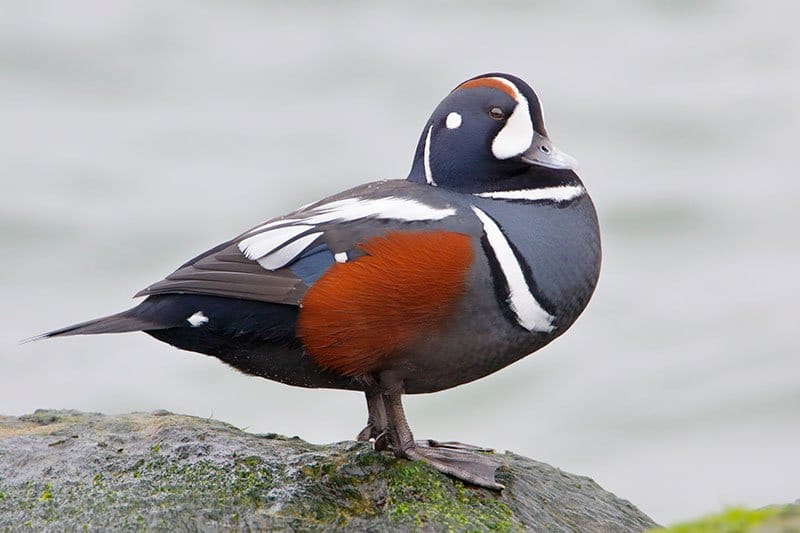
The harlequin duck is a small, round seaduck, with a large, rounded head, steep forehead and short bill. The male in breeding plumage has dark blue upperparts, with white scapulars with narrow, dark grey edges. The upperwing is blue-grey with black flight feathers and there is a white wingbar and purple-blue speculum. The underparts are blue-grey with chestnut flanks, and vertical white bars bordered with black on each side of the breast. On the rump there is a small white spot.
The head is blue-grey with a white crescent at the base of the bill, a white ear patch, a white neck collar, and a white stripe on the sides of the neck. There is a black stripe from the bill to the top of the crown bordered with white and chestnut. The eyes are red, and the bill is blue-grey with a black tip.
The female is dark brown with white undertail coverts, and white patches under and in front of the eye and on the forehead. The male in eclipse plumage resembles the female but is darker.
Try our interactive bird identifier
Harlequin ducks feed mainly on molluscs, crustaceans, and insects during breeding season. At sea, it eats shellfish, aquatic insects, small fish, and marine worms. It catches prey mostly by diving.
Harlequin ducks breed in Greenland, Iceland, Siberia, and northern North America alongside fast flowing rivers, lakes, waterfalls, and rapids, forested mountains, and rocky areas with trees. It migrates to spend the winter on lakes and coasts in southern and western Europe, eastern China, and the southern United States.