Breeding birds: 617 pairs (and 29 on the Isle of Man)
Family: Hawks, Eagles, And Kites
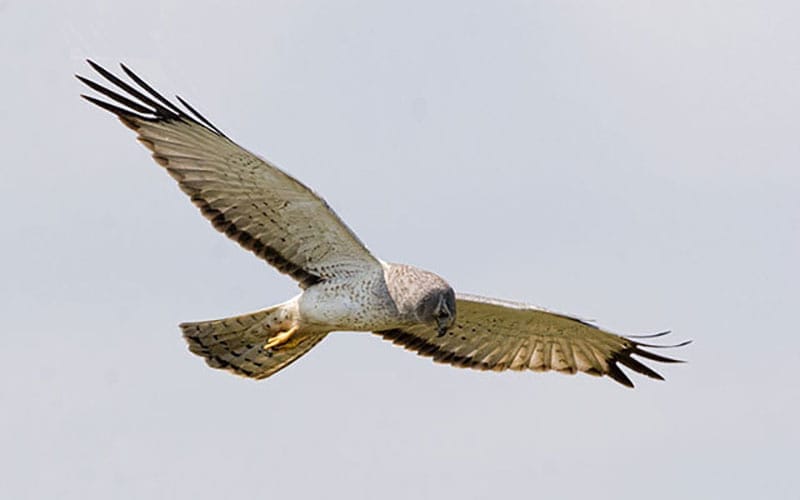
Adult male hen harriers have pale blue-grey upperparts and white underparts, except for the breast which is grey. Their rumps are white, and they have grey wings with conspicuous black wing tips.
Their heads are darker grey and they have yellow eyes and beak, and yellow legs and feet.
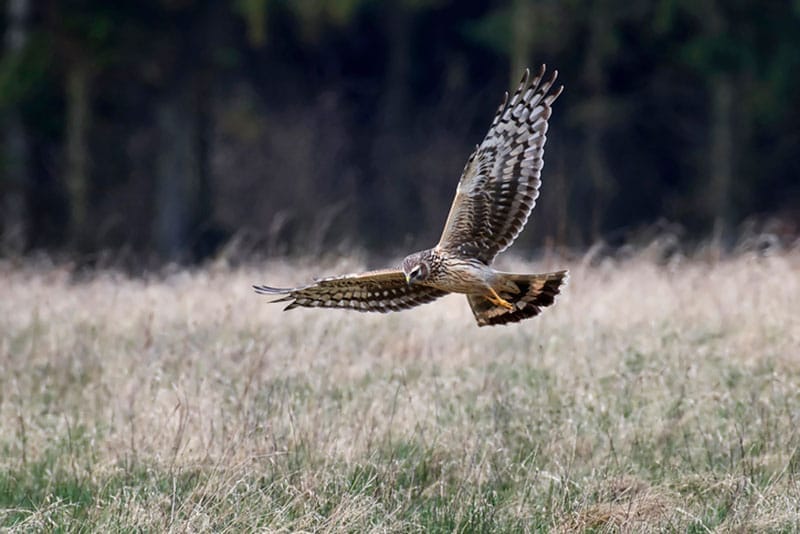
Female hen harriers are larger than the males. They have golden brown upperparts and paler grey-brown underparts which are streaked with dark brown. The undersides of the wings are a brown and grey chequerboard pattern. They have white rumps and a long, barred tail which gives hen harriers the nickname ringtail.
Females have brown crowns and napes with a pale buff facial disc. They have yellow eyes, grey beaks with a yellow cere, and yellow legs and feet.
Juveniles are similar to females but with less barring and fewer streaks on their bellies.
Try our interactive bird identifier
Hen harriers build their nests on the ground on a mound of earth of vegetation. It is made from sticks and lined with grass and leaves.
Hen harriers lay 4-8 whitish eggs which are incubated mostly by the female for 31-32 days. During this time the male hunts and brings her food. After hatching the chicks are fed by both parents although the male will usually pass food to the female to feed to the chicks. They fledge at around 36 days and reach sexual maturity at 2 years for females and 3 years for males.
Hen harriers eat mostly mammals but will also take small birds, eggs, reptiles, and insects.
Hen harriers can be seen in open areas with little vegetation.
During breeding season they can be found on the moorlands of Wales, Northern England, Northern Ireland, and Scotland.
In winter they move to lowland farmland, coastal marshes, fenland and river valleys.
Britain's Birds
RSPB Handbook Of British Birds

Collins Bird Guide
Hen harriers are one of the few raptors to practice polygyny where one male mates with several females. On the Orkney Islands a study showed that rates of polygyny were influenced by food levels. Males given extra food mated with more breeding females than those in a control group that received no extra food.