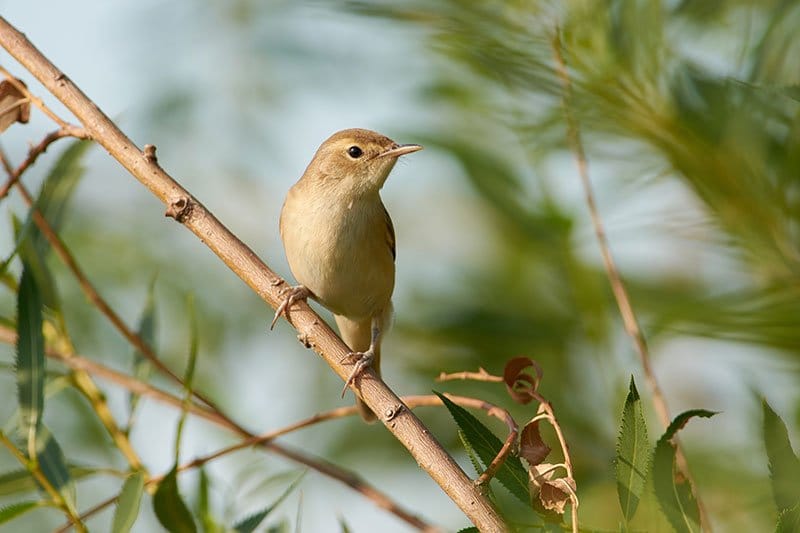
The marsh warbler is a scarce summer visitor to the UK which can be difficult to distinguish from the reed warbler. It is known for its high level of mimicry by the males, incorporating a wide variety of the calls of other songbirds into its song, but also waders, hornbills, and pigeons. It has never been widespread in the UK, but numbers dropped severely from the 1930s and breeding birds are now confined to a few areas in the south east of England.
UK breeding birds: 2-8 pairs
Family: Reed warblers
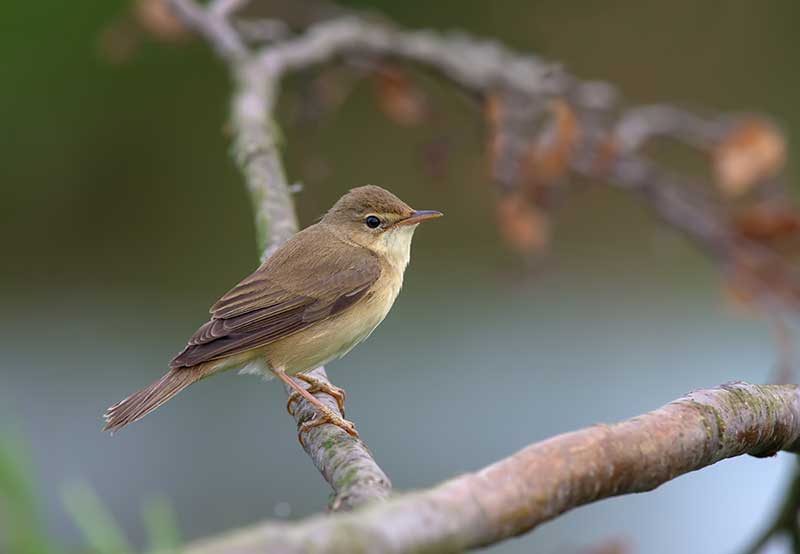
Adult marsh warblers have dull, olive-brown upperparts with black edges to the feathers on the wings and pale tertial fringes, and a yellowy-brown rump. The underparts are pale buff with a white throat.
On the head, the crown, face, and forehead are olive-brown, and there is a thin, black line through the eye and a pale brown eye-ring. The bill is dark grey above and pale orange below, the eyes are dark brown, and the legs and feet are pinkish-yellow or grey. Males and females are similar.
Juvenile marsh warblers resemble adults, but the rump is a warm brown colour, and primaries have white tips.
Try our interactive bird identifier
Marsh warblers breed from late May to mid June and produce 1 brood a season. They are usually monogamous but may occasionally be polygamous. They breed in scrub, grassland, or damp meadows, and often near water. The nest is a cup-shaped structure placed near the ground and made from dry grass lined with roots and plant down.
Marsh warblers lay 3-6 smooth, glossy, pale blue, green, or grey eggs with olive or reddish-brown spots which are incubated by the male and female for 12-14 days. Both parents feed and care for the chicks which fledge at 10-11 days after hatching. They reach sexual maturity at 1 year.
Marsh warblers eat mainly insects, spiders, and snails, but will supplement their diet with berries in autumn and winter. They glean prey from vegetation but will also catch them in the air or from the ground.
Marsh warblers are rare breeding visitors to the UK but can more often be spotted on passage along the east coasts of England and Scotland. Look out for them in marshy vegetation with tall bushes, and scrub.
Britain's Birds
RSPB Handbook Of British Birds
Collins Bird Guide
The marsh warbler is one of the avian world’s best mimics and was the first bird to be found to mimic the sounds of birds on both its summer and winter grounds.