


A large thrush with a long tail that runs and stops across the ground. Males are black with a yellow bill and eye ring. Females are brown with streaked breasts and a pale throat. Her bill is dark, or yellow with a dark tip. In flight the wings and tail are broad and the male has a paler outerwing. They often raise their tail on landing and have a loud, mellow, fluty song which is best heard at dusk.
Blackbirds can be spotted foraging on the ground picking the grass and earth to find worms. They’ll enjoy fruit left out for them on bird tables or the ground.

A small, barrel-bodied, acrobatic tit that visits trees, shrubs, and bird tables. Its strong grip allows it rest at any angle. A bright blue cap surrounded by white on the face and black on the chin and through the eyes. Blue wings and tail, and yellow underparts with a darker streak down the centre. Females can sometimes look greener. Has a high, sharp call and a slurred song. Can often be found in mixed flocks with other tits.
Blue tits’ natural diet consists of insects, caterpillars, and beetles, but they’ll happily eat from bird feeders, in particular nuts and sunflower seeds.

A sparrow-sized finch with a long body. Male has orange-pink underparts, a greenish rump, dark wings with white wing bars which distinguish it from other finches. The face is orange-pink with a blue-grey cap. The female is duller, olive-grey above, and olive-buff below. Thick seed-eating slate-grey bill. Often tame around car parks and gardens. Song is bright and rattling, while call is monotonous, repeated over long periods in the summer.
Chaffinches can be shy birds preferring to eat undercover. Sprinkle seed mixes near shrubs and hedges to encourage them to visit your garden.

Neat, elongated dove often found on the ground, TV aerials, wires, and roofs. Pale greyish-sandy plumage with a thin black collar. Dark-tipped wings with a grey panel. In flight the underwing is soft, pale grey, and the underside of the tail has a black base and broad white tip. Monotonous triple call. Flight call is nasal. Wings clatter less than pigeons but can whistle loudly in short, fast flights.
Collared doves eat mainly seeds and grain although they’ll occasionally eat berries and insects too. A high energy seed mix will attract them to your garden.

Small, dark, sparrow-like bird but with a fine bill. Delicate and shy, it creeps along the ground looking for food. Heavily streaked upperparts and flanks, grey underparts, and face. Thin, orange-brown legs, and reddish eye. Often found in groups with spread wings or shuffling and creeping on flexed legs. Call is a bright, even whistle, while song is a fast, high warble with even speed and pitch.
Dunnocks are primarily ground-feeding birds and flick their tail as they eat insects and spiders. Offer them some live or soaked dried mealworms for a tasty treat.

Small, dainty finch with a conspicuous red face and yellow on wing. The upperparts are dull brown, and the underparts are buffy-white with brown breast patches. Wings are black, rump is white, and tail is black with white spots at the tip. Feeds on seeds of thistle, teasel, and other weeds. Perches high in leafy trees and often in groups of between 5 and 10 or more where food is abundant. Distinctive tinkling call, often heard when birds are flying.
Sunflower hearts are a firm favourite with goldfinches. Fill up a special feeder and you should soon have a charm come flocking to your garden.

Medium-sized woodpecker with a bold, distinctive pattern. Jerky movements in trees and on bird feeders. Black and white upperparts, and buff underparts. Barred black and white wings visible in flight. Vivid red under the tail and male has red patch on the back of the head. Large oval white patch on the side of the back. Female has an all black nape and weaker red under the tail. Drums in spring, hammering bill on a tree trunk or branch. Deep undulating flight. Loud, abrupt call, and squeaky, rattling alarm call.
Great spotted woodpeckers typically feed by picking insects from the crevices in trees. Offer them a suet log feeder if you want them to visit your garden.

Large, bulky tit that is more boldly patterned than the blue tit or coal tit. Green upperparts with blue wings and white wingbar. Underparts are pale yellow with a black stripe down the centre of the belly. White sides to the blue tail. The head is black with a white oval cheek. Acrobatic feeder but will also probe on the ground. Loud, see-sawing song, while the call is a variety of off-key notes.
In the wild, great tits eat mainly insects but they’re common visitors to gardens and will enjoy tucking into nuts, sunflower heats, and seed mixes.

Large, upright finch with a stout bill. Male is drab to bright green, with yellow streaks on the grey wings and tail. In winter, grey fringes develop on the feathers. Dark through the eyes and a pale bill. Female is brownish-green with soft streaks above and narrow yellow streaks on the wing. Song is a series of musical trills, often performed while rolling. Feeds in fields and under trees, and flies in tight flocks.
Greenfinches’ beaks have adapted to feed on seeds so if you want to see these birds in your garden offer them niger and other small seeds, which they’ll eat, often side-by-side with goldfinches.

Small, lively, sociable, and noisy birds. Male has rusty-brown upperparts with a broad, white wingbar, and pale grey underparts. Reddish-brown hindneck and grey crown, pale grey cheek, and black throat and bib. Out of breeding season, the bib is lost. Female is pale sandy-brown with two buff streaks on back, and pale grey underparts. Broad buff stripe over the eye. Forms large flocks in hedgerows and thickets. Call is a series of loud chirrups and cheeps, and unmusical song is similar.
House sparrows have a diverse diet and will eat just about anything. Use up your leftover cheese, nuts, crumbs, and suet to make a delicious homemade fat treat.

Medium-sized corvid with wide wings, and a long tail. Pinkish overall with greyer back, black and white wings with a patch of bright blue, large white rump, obvious in flight, and black tail. Black and white streaked crown and black moustache. Hops in springy bounds on the ground but usually secretive. Often flies in pairs one after the other across roads and clearings with elastic wingbeats. Found in woodlands and parks, Voice is a loud ‘mewing’, while alarm call is a harsh screech.
Jays love acorns and other nuts and can often be seen carrying them to their winter stores in autumn. Try unshelled peanuts if you want them to visit your garden.

Tiny, acrobatic tit with a long, slim tail. Dark upperparts with a pink shoulder, and white edges on the wings. Underparts are pink with a white belly. Tail is black with white sides. The head is pink with black and white stripes on the crown. Eyes have a distinctive red eyelid. Found in small groups flying “follow my leader” style from shrub to shrub with audible whirring wings, as well as in mixed flocks with other small birds, in woodland, hedgerows, and thickets. Thin, high call mixed with dry trills.
Long-tailed tits often feed in flocks and will readily feed from bird feeders, fat balls, and suet blocks.

Unmistakeable, large, pied corvid with a very long tail. Back, head, and breast are dull black, while wings have a blue gloss. Large white shoulder patch, belly, and wingtips. Tail is glossed with green, blue, and purple. Juvenile is short-tailed at first but unmistakably a magpie. Often seen in small groups, as well as singularly, or in pairs. Widespread wings when flying on steady, quick beats, and closed-wing dives to the ground or perch. Loud, harsh chattering call.
Magpies are opportunistic feeders and will sometimes take the eggs and chicks of other birds. Divert their attention with kitchen scraps or even dog and cat food.

Cocky bold birds with plain brown backs, orange-red faces and bibs edged with grey. They are territorial even in winter and sing loudly from perches to keep away rival birds.
Robins can be very protective over food sources so give them their own special feeder filled with mealworms, raisins, mild grated cheese, and crushed nuts.

Pale brown back, v-shaped spots on cream breast. Musical strident song with each short phrase repeated several times.
Song thrushes forage in leaf piles in search of caterpillars, worms, and snails. Leave berries and windfall apples on the ground to encourage them into your garden.

Blackish, glossy plumage, heavily spotted white in winter. Short-tailed, smaller than blackbirds. Good mimic of other birds and mechanical sounds.
Starlings can be aggressive feeders and will often arrive at bird tables and feeders in large flocks. Suet-based foods will keep their energy levels up.

Large pigeon with white on neck, pink breast and white marks on wings. Takes off with a clatter of wings. Deep chest noticeable in flight.
Wood pigeons will eat from a bird table sometimes not allowing smaller birds to get a look in. Put out peanuts, sunflower hearts, and seed mixes for a healthy all-round diet.
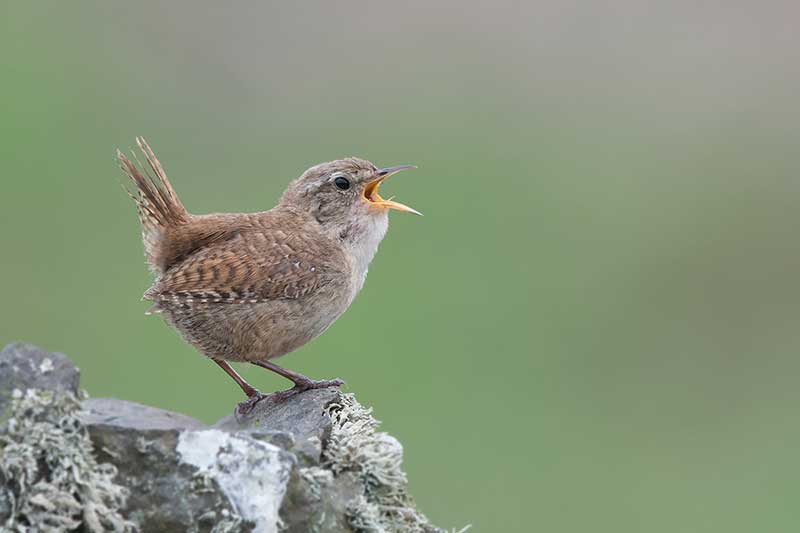
Tiny, rusty brown. Pale line over eye and barred wings. Short, dry, irritated call and loud, strident song. Moves mouselike through undergrowth.
Wrens are very secretive and although they are the UK’s most common bird can be hard to spot in the garden. Scatter some mealworms or slices of fruit smeared with peanut butter near the base of hedges and shrubs.


98 Responses
Late afternoon yesterday – and I have just seen a squadron of small birds with yellow/black flashes. They were flying in formation – the same way starlings do. First time I have ever seen that in East London. Probably a Greenfinch – but I didn’t get any photos to confirm
there are quite a few cockatiels and parakeets in london now
Spotted a smallish bird with LONG THEN NECK that made us notice it. It swooped over a magpie that stood on the grass and landed 50 yards away. It had light grey/fawn underbody and reddish brown wings. It hops and found worms. We can’t find anything like it. Wondering if it is a new hatch
Just seen a small brown/beige warbler type bird on windowsill – had a bright yellow top of head (like it was wearing a hat!!), tiny size, longish thin beak. Cannot see anything in my book like it. Wonderful little thing, smaller than a robin, more like a blue tit size. Any help on what it is?? Cannot find anything under “yellow cap” type birds.
Hi Judith,
sounds like a Firecrest
Sorry Judith, I meant Goldcrest, Firecrest is similar, but has a red cap.
Sounds like the UK’s smallest bird Judith…… a Goldcrest.
A few times I have seen a bird on my outdoor feeders, it is sparrow size but it has very dark feathers, not like a tree or house sparrow plumage. Have tried rspb site but cannot see any bird it is like. Any suggestions on this bird gratefully received.
I’ve just seen a goldish/very bright brown with a flicker of white on his/her tail and cant seem to find out what sort of bird it is? I’m a Newby lol..
It sounds like a Dunnock its the same size but darker, look it up and see
I saw a small bird in my garden I hadn’t seen before. It was a beige/brown colour, had a black face with white stripe around it, and a golden/light orange beak. The tail was black with white dots and had a stripe around it the same colour as the beak. Really stumped as I can’t find any pictures of the bird on google!
Just seen a bird in my garden it was the size of sterling it was black with blue and white stripe on wings and a white beak
12th Feb 2023. Saw a small pair of birds climbing up a tree together. Size of a goldcrest but these were very dark to black on their backs with white underneath. Too small for treecreepers and they were darker and more delicate. The tree was was amongst a line of trees along the river bank (River Wyre in Garstang, Lancs) just outside the gardens.
Are they just passing through because I can’t find them in my Collins Guide?
Thank you
I have a visitor with a curved brown beak, same size as a blackbird, brown with a red/russett coloured chest. Intrigued as to what it may be can you help please?
I think this sounds like a juvenile female blackbird.
Just had two very dark brown birds, size of blackbirds but rounder. Male had a reddish tinge to its chest, brown straight beak. Female had a buff chest otherwise same as male. Any ideas?? Foraging in the flower beds.
I saw a bird in my garden it was eating from the feeders it was similar size and look to a starling but it had a cream under belly and brown cream and black markings on its head. Its also had glossy feathers.
A bird has been a frequent visitor to my garden. It is the same size as a blackbird, with a light brown head and beak, and a dark brown body. Any ideas for its identity?
Possiby a female blackbird.
Definitely a female blackbird.
We have a garden bird with a long, black, sharp pointed, woodpecker type beak, light brown head and chest with a black stripe on its face, a black and white spotted underbelly and a dark stripe on its wings.
Can anyone identify it for me please?
It may be a young bird.
Thank you
A juvenile jay?
Sounds a bit likea nuthatch
But they have a pinky brown belly
We are very lucky to have a very mature garden surrounded by fields. (SE) We see all sorts of birds and love watching them. We get all the usual, plus goldfinches, bullfinches, all the tits including coal tits, tiny little goldcrests, tons of swallows, nuthatches, treecreepers and this year, we are lucky to watch the aerobatics of a whole family of spotted flycatchers! It’s taken us a week or two to identify them, and if you think the tits are aerobatic, you want to watch these, they are hilarious. One dived into a hedge after a bug right in front of me!
Very confused; saw a small bird today but can find nothing online to help identify it ;o(
It looked/behaved like a young bird, was Chaffinch proportions, and as best I could see had sort of Pinky/Peachy Chest and underparts, Sparrow-esque Brown Back with White Flashes within the Wings, a Bright Red cap, and thin black Eye Stripes.
It flew away as soon as I tried to photograph it.
Can anyone help?
Possibly a Bullfinch
Possibly a Lesser Redpoll
Just seen a taupe colour bird with yellow under wing . Bit smaller than a jay
I have just seen this amazing looking bird on my fence eyeing up the bird feeder, about the size of a Jay with a long beak body feathers dark brown with cream slashes over its back and underneath the back end looked pinky red…any ideas please.
I saw a large bird with a blue breast and a white head with a black stripe, pale brown in the rest of the body. About the size of a crow. Seen on the border of Hampshire and Surrey
Can’t find out what it was, could someone email me with suggestions please
I saw a bird slightly bigger than a wren brown with a red speckled breast can you help with I.d.
Hi. That was probably a Robin Redbreast bird. Their red breast is entirely unique to that bird.
We have had a white Starling feeding in our garden for the last three mornings, it really stands out from the pack. never seen one previously. Have good images if required.
I was walking in woodland this morning. I saw a bird that I didn’t recognise. It was the size of a blackbird. The feather was black, it had a white cap (top of head) and white throat. Does anyone know what I saw
I just saw something similar . Bout size of a black bird with a white patch running down back of neck
I saw a black and white pigeon sitting on the roof opposite with a normal coloured pigeon this morning,i am sure i’ve seen one around before here quite a long time ago.
I am in Farnborough/Kent.
I have loads of pigeons that come in my garden. Brown and white, black, black and white, normal grey and an all white. To be honest they are a problem, with approx 50 plus every day they are eating the other birds food. I have got the feeders to stop them getting to the food, but they are always able to knock them to the ground. And soon there will be more after the breeding this year. Does anyone know how I can deal with this?
Check out your local pgeon fanciers as those sound like racing pigeons and show birds or their feral off spring
Just seen 2 sparrow like looking birds in my garden but they both had white stripes down the top of their heads. Any idea what they are? I’m in the Midlands.
Small finch sized bird found (sadly crashed into a window) dead
Light grey feathers on its back with a black tail that has white feathers at the top nearest it’s body not tip
Breast feathers are peachy pink.
Not seen anything like it in my uk garden before.
Can I send a picture?
Jan used to have birds crashing into our patio doors, we stopped this by getting window stickers from RSPB.
Sorry not sure on bird species
That’s a bullfinch, beautiful birds.
We have 2 pink breasted quite ordinary looking browny grey birds in the garden . Definitely not a robin and not like any chaffinch . Any ideas what it could be.
Sounds like a bullfinch, perhaps.
Might be a nuthatch if it looks like it’s wearing mascara and has a fairly long beak.
Sounds like long tailed tits,they are pink.